Experiments / SPICE flow duct
BASSA spacecraft fire-safety study
Burning and Suppression of Solids
Burned small solid samples in a fan-driven duct to see how real materials burn without gravity, and whether a nitrogen jet puts them out.
What burned
Solid materials
Acrylic plastic, cotton fabric, wax and 2 more
Where
On the space station
In orbit, where everything is weightless
How much data
121 tests
Each one is a row in NASA's table
What they changed between tests
- sample material
- sample shape and size
- flow direction
- flow speed
- nitrogen suppressant
What it found
- 1 of 2
NASA's materials screening test is run at normal gravity and does not account for low-gravity behaviour.
NASA's words
“Current NASA spacecraft materials selection is based on a standard test method (NASA–STD–6001 Test 1) that segregates material based on 1-g behavior without consideration of low gravity effects.” PSI record
- 2 of 2
The working hypothesis is that, with ventilation, a material burns at least as well in microgravity as on Earth.
NASA's words
“materials in microgravity, with adequate ventilation, burn as well if not better than the same material in normal gravity” PSI record
Summarized by the SI. Each summary is tied to a quotation that the build checks against NASA's text. A matching quote is not a scientific review.
What it helps with
Stopping a fire from starting
Which materials burn, and in what air
A main aim
Noticing a fire early
What smoke looks like to a detector
Not an aim
Putting a fire out
What makes a flame go out
A main aim
For researchers: NASA's full recordThe conditions tested, every row of the table, NASA's description, publications and hardware
Shared hardware: One small fan-driven wind tunnel, built for SPICE, was reused for solids and for jet flames. Experiments that shared hardware share its limits, so their results can be compared directly.
Why it counts as fire-safety research
“Flammability studies focus on solid materials such as fabrics and plastics, as studied in the Burning and Suppression of Solids (BASS and BASS-II) and Spacecraft Fire Safety Demonstration (Saffire-I, -II, and -III) investigations.” NASA challenge statement
NASA's words behind each rating
- Prevention3 of 3
“Begin to bridge the gap between the normal gravity NASA-STD-6001 Test#1 method, ground-based microgravity tests, and actual material flammability in microgravity.”
- Detection0 of 3
Not an aim of this investigation.
- Suppression3 of 3
“Assess the effectiveness of an inert, gaseous extinguishing agent (similar to that used on ISS) in putting out flames over different materials, geometries, preheating, and flow.”
Conditions covered
- Oxygen in the atmosphere
- 15.9% to 22.7%
- airMoon
- Pressure
- 98.3 kPa to 102 kPa
- Moonsea level
- Flow speed
- 0 to 44 cm/s
- Itemized rows
- 121
- 121 tests
Fuels and materials
PMMA (78), SIBAL fabric (cotton/fiberglass) (12), Japan wax (10), Paraffin wax (7), Nomex (6), Wax (6), Ultem (2)
Measurements named in the PSI record
- Radiometry
- Flow velocity
How the tests differ, and how they are the same
Worked out from the 121 rows of the PSI table. A variable that is not listed was not reported, which is different from being held fixed.
Changed from test to test
- Oxygen
- 15.9% to 22.7%
- Pressure
- 98.3 kPa to 102 kPa
- Flow speed
- 0 cm/s to 44 cm/sreported in 95 of 121 rows
- Fuel or material
- 7 different values
- Geometry
- 5 different valuesreported in 101 of 121 rows
- Characteristic size
- 10 mm to 20 mmreported in 47 of 121 rows
- Sample width
- 1 cm to 2 cmreported in 36 of 121 rows
- Ignited
- 2 different valuesreported in 42 of 121 rows
- How the test ended
- 5 different valuesreported in 69 of 121 rows
The same in every test
- Fuel phase
- solid
Reported for only some rows, with one value: flow direction.
Rows from the PSI table
Click a row for the source of every value. Filter and export
| Record | Type | Fuel or material | Shape | Oxygen | Pressure | Flow, cm/s | Outcome | Date |
|---|---|---|---|---|---|---|---|---|
| Test 1 | Test | SIBAL fabric (cotton/fiberglass) | fabric sheet | 22.1% | 98.3 kPa | 5 to 10 | burned to completion | 2012-03-30 |
| Test 42 | Test | PMMA | sphere | 22.1% | 98.3 kPa | 3 to 10 | 2012-03-30 | |
| Test 18 | Test | PMMA | sphere | 22.1% | 98.3 kPa | 3 to 10 | flow terminated | 2012-03-30 |
| Test 7 | Test | SIBAL fabric (cotton/fiberglass) | fabric sheet | 21.9% | 98.3 kPa | 10 | 2012-04-05 | |
| Test 8 | Test | SIBAL fabric (cotton/fiberglass) | fabric sheet | 21.9% | 98.3 kPa | 5 | 2012-04-05 | |
| Test 43 | Test | PMMA | sphere | 21.7% | 99.3 kPa | 6 to 10 | 2012-04-09 | |
| Test 44 | Test | PMMA | sphere | 21.7% | 99.3 kPa | 2 to 10 | 2012-04-09 | |
| Test 45 | Test | PMMA | sphere | 21.7% | 99.3 kPa | 1 to 10 | extinction | 2012-04-09 |
| Test 19 | Test | PMMA | sphere | 21.9% | 100 kPa | 6 | flow terminated | 2012-05-02 |
| Test 20 | Test | PMMA | sphere | 21.9% | 100 kPa | 0 to 6 | flow terminated | 2012-05-02 |
| Test 21 | Test | PMMA | sphere | 21.9% | 100 kPa | burned to completion | 2012-05-02 | |
| Test 4 | Test | SIBAL fabric (cotton/fiberglass) | fabric sheet | 21.6% | 99.7 kPa | 22 | 2012-05-10 | |
| Test 10 | Test | SIBAL fabric (cotton/fiberglass) | fabric sheet | 21.6% | 99.7 kPa | 11 | 2012-05-10 | |
| Test 12 | Test | Nomex | fabric sheet | 21.6% | 99.7 kPa | 15 | did not ignite | 2012-05-10 |
| Test 54 | Test | PMMA | 21.7% | 99.7 kPa | 11 | extinction | 2012-05-11 | |
| Test 55 | Test | PMMA | 21.7% | 99.7 kPa | 6.5 | flow terminated | 2012-05-11 | |
| Test 56 | Test | PMMA | 21.7% | 99.7 kPa | 3.5 to 6 | flow terminated | 2012-05-11 | |
| Test 57 | Test | PMMA | 21.7% | 99.7 kPa | extinction | 2012-05-11 | ||
| Test 110 | Test | PMMA | 21.7% | 99.7 kPa | 6.5 to 21 | flow terminated | 2012-05-11 | |
| Test 30 | Test | PMMA | 21.2% | 98.5 kPa | 5.5 | 2012-06-05 | ||
| Test 31 | Test | PMMA | 21.2% | 98.5 kPa | 2 to 6 | extinction | 2012-06-05 | |
| Test 32 | Test | PMMA | 21.2% | 98.5 kPa | 0 to 5 | extinction | 2012-06-05 | |
| Test 33 | Test | PMMA | 21.2% | 98.5 kPa | 0 to 5 | 2012-06-05 | ||
| Test 12-R | Test | Nomex | fabric sheet | 21.2% | 98.5 kPa | 9 | did not ignite | 2012-06-05 |
| Test 12-R2 | Test | Nomex | fabric sheet | 21.2% | 98.5 kPa | 9 | did not ignite | 2012-06-05 |
| Test 46 | Test | PMMA | sphere | 21.2% | 99.9 kPa | 0 to 9.5 | flow terminated | 2012-06-11 |
| Test 47 | Test | PMMA | sphere | 21.2% | 99.9 kPa | 0 to 9 | 2012-06-11 | |
| Test 48 | Test | PMMA | sphere | 21.2% | 99.9 kPa | 0 to 9 | 2012-06-11 | |
| Test 49 | Test | PMMA | sphere | 21.2% | 99.9 kPa | 0 to 9 | flow terminated | 2012-06-11 |
| Test 22 | Test | PMMA | sphere | 20.9% | 100 kPa | 0 to 9.75 | flow terminated | 2012-06-14 |
| Test 23 | Test | PMMA | sphere | 20.9% | 100 kPa | 0 to 10 | flow terminated | 2012-06-14 |
| Test 24 | Test | PMMA | sphere | 20.9% | 100 kPa | 0 to 10 | flow terminated | 2012-06-14 |
| Test 25 | Test | PMMA | sphere | 20.9% | 100 kPa | 4 | burned to completion | 2012-06-14 |
| Test 58 | Test | PMMA | sphere | 21.7% | 98.9 kPa | 4 to 9 | 2012-06-18 | |
| Test 59 | Test | PMMA | sphere | 21.7% | 98.9 kPa | 0 to 11 | 2012-06-18 | |
| Test 60 | Test | PMMA | sphere | 21.7% | 98.9 kPa | 0 to 7 | flow terminated | 2012-06-18 |
| Test 61 | Test | PMMA | sphere | 21.7% | 98.9 kPa | 2 to 6.5 | flow terminated | 2012-06-18 |
| Test 5 | Test | SIBAL fabric (cotton/fiberglass) | fabric sheet | 22% | 98.9 kPa | 5.75 | extinction | 2012-06-28 |
| Test 14 | Test | Nomex | fabric sheet | 22% | 98.9 kPa | 14.5 | extinction | 2012-06-28 |
| Test 66 | Test | PMMA | slab | 22% | 98.9 kPa | 4 to 10 | self-extinguished | 2012-06-28 |
| Test 67 | Test | PMMA | slab | 22% | 98.9 kPa | 2012-06-28 | ||
| Test 34 | Test | PMMA | sphere | 21.9% | 100 kPa | 0 | flow terminated | 2012-06-29 |
| Test 35 | Test | PMMA | sphere | 21.9% | 100 kPa | 0 | burned to completion | |
| Test 16 | Test | Ultem | sheet | 21.9% | 100 kPa | 14.5 | did not ignite | 2012-06-29 |
| Test 5b | Test | SIBAL fabric (cotton/fiberglass) | fabric sheet | 21.9% | 100 kPa | 10 | extinction | 2012-06-29 |
| Test 6 | Test | SIBAL fabric (cotton/fiberglass) | fabric sheet | 22.2% | 100 kPa | 9 | burned to completion | 2012-07-03 |
| Test 82 | Test | Wax | candle | 22.2% | 100 kPa | extinction | 2012-07-03 | |
| Test 82a | Test | Wax | candle | 22.2% | 100 kPa | extinction | 2012-07-03 | |
| Test 82b | Test | Wax | candle | 22.2% | 100 kPa | 5 | burned to completion | 2012-07-03 |
| Test 68 | Test | PMMA | slab | 22.2% | 100 kPa | 6 | self-extinguished | 2012-07-03 |
| Test 69 | Test | PMMA | slab | 22.4% | 100 kPa | 10 | extinction | 2012-07-12 |
| Test 111 | Test | PMMA | sphere | 22.4% | 100 kPa | 10 | flow terminated | 2012-07-12 |
| Test 112 | Test | PMMA | sphere | 22.4% | 100 kPa | 10 | flow terminated | 2012-07-12 |
| Test 113 | Test | PMMA | sphere | 22.4% | 100 kPa | 10 | extinction | 2012-07-12 |
| Test 2 | Test | SIBAL fabric (cotton/fiberglass) | fabric sheet | 22.7% | 101 kPa | 9 to 44 | 2012-07-19 | |
| Test 3 | Test | SIBAL fabric (cotton/fiberglass) | fabric sheet | 22.7% | 102 kPa | 10 to 44 | 2012-07-19 | |
| Test 15 | Test | Nomex | fabric sheet | 22.5% | 102 kPa | 30 | did not ignite | 2012-07-19 |
| Test 13 | Test | Nomex | fabric sheet | 22.5% | 102 kPa | 15 | extinction | 2012-07-19 |
| Test 17 | Test | Ultem | sheet | 22.5% | 102 kPa | 8 | extinction | 2012-07-19 |
| Test 114 | Test | PMMA | sphere | 22.5% | 102 kPa | 6.5 | 2012-07-19 | |
| Test 62 | Test | PMMA | sphere | 22.6% | 102 kPa | 10 to 44 | 2012-07-23 | |
| Test 63 | Test | PMMA | sphere | 22.6% | 102 kPa | 10 | 2012-07-23 | |
| Test 64 | Test | PMMA | sphere | 22.6% | 102 kPa | 5 | blowoff | 2012-07-23 |
| Test 65 | Test | PMMA | sphere | 22.6% | 102 kPa | 5 | 2012-07-23 | |
| Test 118 | Test | PMMA | sphere | 22.6% | 102 kPa | 2012-07-23 | ||
| Test 11 | Test | SIBAL fabric (cotton/fiberglass) | fabric sheet | 21.5% | 100 kPa | 20 | 2012-08-09 | |
| Test 9 | Test | SIBAL fabric (cotton/fiberglass) | fabric sheet | 21.6% | 100 kPa | 10 | burned to completion | 2012-08-09 |
| Test 102 | Test | PMMA | sphere | 21.6% | 100 kPa | 5 | 2012-08-09 | |
| Test 83a | Test | Japan wax | candle | 21.2% | 98.5 kPa | 0 | extinction | 2012-08-16 |
| Test 83b | Test | Japan wax | candle | 21.2% | 98.5 kPa | 0 to 2 | 2012-08-16 | |
| Test 83c | Test | Japan wax | candle | 21.2% | 98.5 kPa | 0 to 2 | burned to completion | 2012-08-16 |
| Test 84a | Test | Japan wax | candle | 21.2% | 98.5 kPa | 0 to 2 | extinction | 2012-08-16 |
| Test 84b | Test | Japan wax | candle | 21.2% | 98.5 kPa | 0 to 2 | 2012-08-16 | |
| Test 86a | Test | Japan wax | candle | 21.2% | 98.5 kPa | 0 to 2 | flow terminated | 2012-08-16 |
| Test 86b | Test | Japan wax | candle | 21.2% | 98.5 kPa | 0 to 2 | flow terminated | 2012-08-16 |
| Test 86c | Test | Japan wax | candle | 21.2% | 98.5 kPa | 0 to 1 | burned to completion | 2012-08-16 |
| Test 70 | Test | PMMA | slab | 21.9% | 98.6 kPa | 7 to 9 | 2012-08-21 | |
| Test 71 | Test | PMMA | slab | 21.9% | 98.6 kPa | 9 | 2012-08-21 | |
| Test 74 | Test | Paraffin wax | slab | 21.9% | 98.6 kPa | 3 to 5 | self-extinguished | 2012-08-21 |
| Test 75 | Test | Paraffin wax | slab | 21.9% | 98.6 kPa | 6 | did not ignite | 2012-08-21 |
| Test 98 | Test | PMMA | 17.1% | 98.3 kPa | 12 | 2013-04-05 | ||
| Test 99 | Test | PMMA | 17.1% | 98.3 kPa | 12 | extinction | 2013-04-05 | |
| Test 114 | Test | PMMA | 21.1% | 99.5 kPa | 2 to 7.5 | 2013-04-09 | ||
| Test 115 | Test | PMMA | 21.1% | 99.5 kPa | 0 to 7.5 | 2013-04-09 | ||
| Test 116 | Test | PMMA | 21.1% | 99.5 kPa | 0 to 8 | flow terminated | 2013-04-09 | |
| Test 117 | Test | PMMA | 21.1% | 99.5 kPa | extinction | 2013-04-09 | ||
| Test 117a | Test | PMMA | 21.1% | 99.5 kPa | 0 to 20 | 2013-04-09 | ||
| Test 100 | Test | PMMA | 21.1% | 99.3 kPa | 0 to 8 | extinction | 2013-04-12 | |
| Test 85 | Test | Paraffin wax | candle | 21.1% | 99.3 kPa | 3 | 2013-04-12 | |
| Test 93 | Test | Paraffin wax | candle | 21.1% | 99.3 kPa | self-extinguished | 2013-04-12 | |
| Test 26 | Test | PMMA | 17.3% | 100 kPa | 2013-04-16 | |||
| Test 27 | Test | PMMA | 17.1% | 100 kPa | flow terminated | 2013-04-16 | ||
| Test 28 | Test | PMMA | 17.1% | 100 kPa | burned to completion | 2013-04-16 | ||
| Test 87 | Test | Japan wax | candle | 15.9% | 98.3 kPa | 0 to 2 | extinction | 2013-04-23 |
| Test 103 | Test | PMMA | sphere | 17.5% | 98.3 kPa | 5 | extinction | 2013-04-23 |
| Test 104 | Test | PMMA | sphere | 17.5% | 98.3 kPa | flow terminated | 2013-04-23 | |
| Test 105 | Test | PMMA | sphere | 20.5% | 98.3 kPa | extinction | 2013-04-23 | |
| Test 38 | Test | PMMA | sphere | 16.7% | 98.9 kPa | 6 to 8 | extinction | 2013-04-26 |
| Test 39 | Test | PMMA | sphere | 16.7% | 98.9 kPa | self-extinguished | 2013-04-26 | |
| Test 40 | Test | PMMA | sphere | 17.8% | 98.9 kPa | 0 to 8 | burned to completion | 2013-04-26 |
| Test 72 | Test | PMMA | slab | 21% | 98.9 kPa | 9 | did not ignite | 2013-04-26 |
| Test 73 | Test | PMMA | slab | 21% | 98.9 kPa | 15 | did not ignite | 2013-04-26 |
| Test 118 | Test | PMMA | sphere | 17.3% | 99.6 kPa | extinction | 2013-04-29 | |
| Test 119 | Test | PMMA | sphere | 17.3% | 99.6 kPa | flow terminated | 2013-04-29 | |
| Test 89 | Test | Paraffin wax | candle | 16.1% | 99.5 kPa | extinction | 2013-05-02 | |
| Test 95 | Test | Paraffin wax | candle | 16.1% | 99.5 kPa | 5 to 10 | did not ignite | 2013-05-02 |
| Test 92 | Test | Japan wax | candle | 16.3% | 99.5 kPa | burned to completion | 2013-05-02 | |
| Test 78 | Test | Paraffin wax | slab | 16.3% | 99.5 kPa | self-extinguished | 2013-05-02 | |
| Test 50 | Test | PMMA | sphere | 17.2% | 99 kPa | 5 | 2103-05-15 | |
| Test 51 | Test | PMMA | sphere | 17.2% | 99 kPa | 5 | 2013-05-15 | |
| Test 52 | Test | PMMA | sphere | 17.1% | 99 kPa | 0 to 10 | 2013-05-15 | |
| Test 53 | Test | PMMA | sphere | 17.1% | 99 kPa | 10 | 2013-05-15 | |
| Test 106 | Test | PMMA | sphere | 17.2% | 99.3 kPa | 2013-05-17 | ||
| Test 107 | Test | PMMA | sphere | 17.2% | 99.3 kPa | 2013-05-17 | ||
| Test 108 | Test | PMMA | sphere | 17.2% | 99.3 kPa | extinction | 2013-05-17 | |
| Test 109 | Test | PMMA | sphere | 17.2% | 99.3 kPa | extinction | 2013-06-01 | |
| Test 79 | Test | Wax | slab | 17.4% | 101 kPa | extinction | 2013-06-01 | |
| Test 80 | Test | Wax | slab | 21.2% | 101 kPa | 10 | did not ignite | 2013-06-01 |
| Test 75 | Test | Wax | slab | 21.2% | 101 kPa | 10 | did not ignite | 2013-06-01 |
| Test 53 | Test | PMMA | sphere | 21.2% | 101 kPa | 2013-06-01 | ||
| Test 53a | Test | PMMA | sphere | 21.2% | 101 kPa | 2013-06-01 |
How the table was read, and what was repaired
BASS - solid-fuel burns
PSI-26_Experimental table_BASS.csv
122 rows in the file, 121 kept as records, 1 left out (A cleaning step). The PSI table lists the sample for each burn but not its oxygen, pressure or flow speed.
sha256 ccfc3c54d948b64a1c5d2596a63c7c8019e51df0c91a1d62f039f48fa28c300f · fetched 2026-11-11
Repairs and warnings
- 1 row(s) are not tests and were left out: A cleaning step
NASA's description
Objectives
The two main objectives for BASS are to: 1.) Begin to bridge the gap between the normal gravity NASA-STD-6001 Test#1 method, ground-based microgravity tests, and actual material flammability in microgravity. The relation between these can be investigated by observing flames burning for the longer times available in flight. Practical, realistic (thicker) fuels in typical geometries will be examined, including wake flames which have characteristics of a fire burning behind another object (for example, a fire burning in tight area which may not be easily accessible). 2.) Assess the effectiveness of an inert, gaseous extinguishing agent (similar to that used on ISS) in putting out flames over different materials, geometries, preheating, and flow.
Approach
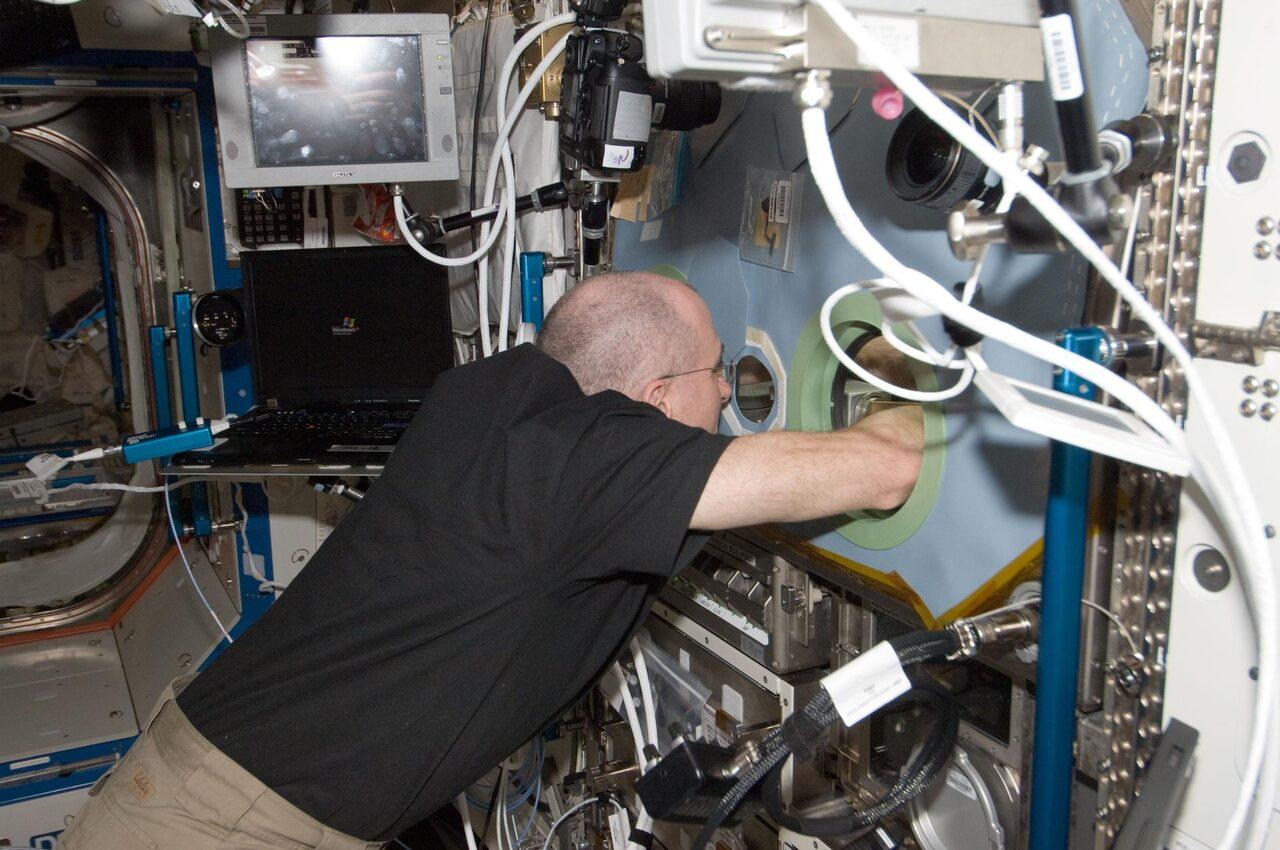
The experiment was conducted aboard the International Space Station (ISS) inside the Microgravity Glove Box (MSG). Custom-made fabric samples consisting of 75% cotton and 25% fiberglass (by mass) measuring were used as a fuel source as well as Nomex fabric and Ultem. A Kanthal wire (29-gage)igniter was used to initiate combustion at one end of the fabric. Airflow was controlled using a variable speed fan, with airflow speeds reaching as high as 40 cm/s. The airflow was directed along the fuel surface in either the opposed or concurrent direction. This investigation explored two primary air flow configurations; concurrent-flow and opposed-flow. With concurrent-flow air flows in the same direction as the flame spread and in opposed-flow air flows in the opposite direction of flame spread. Flames were observed in the top and edge profiles and data was collected on flame size, shape, color, spread rate, and potential flame quenching. The samples were placed in a small flow duct (76 mm x 76 mm cross section) that allowed for airflow across the fabric. Other sample shapes were utilized as well including spheres and cylinders.
Hypothesis
BASS experiments were based on the hypothesis that materials in microgravity, with adequate ventilation, burn as well if not better than the same material in normal gravity with other conditions being identical (pressure, oxygen concentration, temperature, etc.) To test this hypothesis with any but the thinnest materials requires extended microgravity time – longer than available in drop towers or parabolic aircraft.
Research impacts and Earth benefits
Current NASA spacecraft materials selection is based on a standard test method (NASA–STD–6001 Test 1) that segregates material based on 1-g behavior without consideration of low gravity effects. A critical element of this understanding is the radiative heat emission from the flame. These results are used in first order models and predictions of heat release in spacecraft fires and as a means to extend heat release data from tests like the NASA cone calorimeter test (NASA–STD–6001 Test 2) to a performance-based material selection process. Using nitrogen as a flame suppressant in microgravity provides a direct link to current and planned extinguishment techniques. BASS results provide essential guidance to ground-based microgravity combustion research efforts. Detailed combustion models are validated using the simpler flow environment afforded by tests in microgravity. Once validated, they can be used to build more complex combustion models needed to capture the important details of flames burning in normal gravity. These models have wide applicability to the general understanding of many terrestrial combustion problems and will guide novel spacecraft design and ensure the safety of future crewed missions.
Publications
10 listed in PSI, 7 with a DOI.
- The Microgravity Science Glovebox as a Platform for Exploration Research on the International Space StationSpivey Reggie, Luz Paul
- Opposed-flow flame spread: A comparison of microgravity and normal gravity experiments to establish the thermal regimeBhattacharjee Subrata, Laue Matthew, Carmignani Luca, Ferkul Paul, Olson Sandra
- Simplified model for predicting difference between flammability limits of a thin material in normal gravity and microgravity environmentsTakahashi Shuhei, Ebisawa Tomoya, Bhattacharjee Subrata, Ihara Tadayoshi
- A Correlation for an Effective Flow Velocity for Capturing the Boundary Layer Effect in Opposed-Flow Flame Spread over Thin FuelsS Bhattacharjee, R Nagarkar, Y Nakamura
- Radiation signature in opposed-flow flame spreadBhattacharjee Subrata, Paolini Christopher P., Miller Fletcher, Nagarkar Rohit
- OS24-1 The Effect of Boundary Layer on Blow-Off Extinction in Opposed-Flow Flame Spread: Results of Experiments and Simplified Analysis(invited,Scale modeling on solid combustion,OS24 Scale modeling,FLUID AND THERMODYNAMICS)Bhattacharjee Subrata, Cartnignani Luca
Show the other 4
- Role of Gas Radiation in the Mechanism of Opposed-Flow Flame Spread in a Microgravity EnvironmentJR Villaraza, L Carmignani, S Bhattacharjee
- Thickness and Fuel Preheating Effects on Material Flammability in Microgravity from the BASS ExperimentP Ferkul, SL Olson, F Takahashi, M Endo, MC Johnston, JS Tien
- A novel apparatus for flame spread studyS Bhattacharjee, M Bundy, C Paolini, G Patel, W Tran.
- Opposed-Flow Flame Spread in a Narrow Channel Apparatus over Thin PMMA SheetsGR Bornand, FJ Miller, JM Pepper, SL Olson, IS Wichman
Hardware and raw data
164 GB of raw data on PSI: reports 2, raw data 173, metadata 1, presentations 6, science documents 5, engineering documents 24. FlameLens reads the experimental table, not the raw video or sensor files.
Linked investigations
- SPICE
- BASS-II
- BASS flame-spread modelling re-analysed this data
On Earth
Material flammability standards: Radiative heat-release data feeds performance-based material selection and fire models.
“extend heat release data from tests like the NASA cone calorimeter test”