Experiments / SPICE flow duct
BASS-IIA spacecraft fire-safety study
Burning and Suppression of Solids - II
Mapped ignition, flame spread and extinction limits of rods, slabs, films and fabric as oxygen was lowered and airflow changed.
What burned
Solid materials
Acrylic plastic, cotton fabric, flame-resistant fabric and 1 more
Where
On the space station
In orbit, where everything is weightless
How much data
129 tests
Each one is a row in NASA's table
What they changed between tests
- oxygen concentration
- flow speed and direction
- sample material
- sample shape
- sample thickness
What it found
- 1 of 2
Oxygen was only varied downward from 21%, by adding nitrogen - so BASS-II measures limits below cabin oxygen, not the enriched atmospheres planned for the Moon.
NASA's words
“Main variables are airflow speed and oxygen concentration (oxygen varied below 21% by adding nitrogen).” PSI record
- 2 of 2
The upward-burning screening test used on Earth may not be the worst case in space.
NASA's words
“NASA tests and controls materials from a flammability perspective using an upward burning test in normal gravity, which is considered to be the worst-case geometry” PSI record
Summarized by the SI. Each summary is tied to a quotation that the build checks against NASA's text. A matching quote is not a scientific review.
What it helps with
Stopping a fire from starting
Which materials burn, and in what air
A main aim
Noticing a fire early
What smoke looks like to a detector
Touches on it
Putting a fire out
What makes a flame go out
A clear part
For researchers: NASA's full recordThe conditions tested, every row of the table, NASA's description, publications and hardware
Shared hardware: One small fan-driven wind tunnel, built for SPICE, was reused for solids and for jet flames. Experiments that shared hardware share its limits, so their results can be compared directly.
Why it counts as fire-safety research
“Flammability studies focus on solid materials such as fabrics and plastics, as studied in the Burning and Suppression of Solids (BASS and BASS-II) and Spacecraft Fire Safety Demonstration (Saffire-I, -II, and -III) investigations.” NASA challenge statement
NASA's words behind each rating
- Prevention3 of 3
“Study the ignition, flame growth, flame spread, and extinction limits for solid fuels burning in low-velocity forced flows in microgravity.”
- Detection1 of 3
“BASS-II results contribute to the combustion computational models used in the design of fire detection and suppression systems in microgravity and on Earth.”
- Suppression2 of 3
“BASS-II results contribute to the combustion computational models used in the design of fire detection and suppression systems in microgravity and on Earth.”
Conditions covered
- Oxygen in the atmosphere
- 13.6% to 22.2%
- airMoon
- Pressure
- 99.2 kPa to 101 kPa
- Moonsea level
- Flow speed
- 0 to 53 cm/s
- Itemized rows
- 129
- 129 tests
Fuels and materials
PMMA (98), SIBAL fabric (cotton/fiberglass) (27), Nomex (3), Japan wax (1)
Measurements named in the PSI record
- Gas analysis
- Flow velocity
How the tests differ, and how they are the same
Worked out from the 129 rows of the PSI table. A variable that is not listed was not reported, which is different from being held fixed.
Changed from test to test
- Oxygen
- 13.6% to 22.2%
- Pressure
- 99.2 kPa to 101 kPa
- Flow speed
- 0 cm/s to 53 cm/sreported in 125 of 129 rows
- Flow direction
- 3 different valuesreported in 120 of 129 rows
- Fuel or material
- 4 different values
- Geometry
- 6 different values
- Characteristic size
- 6.35 mm to 40 mmreported in 56 of 129 rows
- Sample thickness
- 0.1 mm to 5 mmreported in 42 of 129 rows
- Sample width
- 1 cm to 2 cmreported in 69 of 129 rows
- Ignited
- 2 different valuesreported in 36 of 129 rows
- Burn time
- 384 s to 1,842 sreported in 20 of 129 rows
- How the test ended
- 5 different valuesreported in 93 of 129 rows
- Flame spread rate
- 0.012 mm/s to 0.144 mm/sreported in 18 of 129 rows
- Oxygen at end of test
- 13.5% to 22.2%reported in 122 of 129 rows
- Carbon dioxide at end of test
- 0.2% to 3.2%reported in 123 of 129 rows
- Carbon monoxide at end of test
- 0.3 ppm to 950 ppmreported in 124 of 129 rows
The same in every test
- Oxygen refers to
- ambient
- Diluent
- N2
- Fuel phase
- solid
Rows from the PSI table
Click a row for the source of every value. Filter and export
| Record | Type | Fuel or material | Shape | Oxygen | Pressure | Flow, cm/s | Outcome | Date |
|---|---|---|---|---|---|---|---|---|
| B1 | Test | PMMA | thin film | 22.2% | 101 kPaassumed | 5 | flow terminated | 2014-02-19 |
| B2 | Test | PMMA | thin film | 22.2% | 101 kPaassumed | 5 | 2014-02-19 | |
| B3 | Test | PMMA | thin film | 22.2% | 99.2 kPa to 99.5 kPa | 2 | 2014-02-19 | |
| B4 | Test | PMMA | thin film | 22.2% | 99.2 kPa to 99.5 kPa | 5 | 2014-02-19 | |
| B5 | Test | PMMA | thin film | 22.2% | 101 kPaassumed | 5 | 2014-02-19 | |
| B6 | Test | PMMA | thin film | 21% | 101 kPaassumed | 3 to 10 | burned to completion | 2014-07-07 |
| B7 | Test | PMMA | thin film | 22.2% | 101 kPaassumed | 2 | 2014-02-19 | |
| B8 | Test | PMMA | thin film | 21% | 101 kPaassumed | 10 | 2014-07-07 | |
| B9 | Test | PMMA | thin film | 21% | 101 kPaassumed | 2 | extinction | 2014-07-07 |
| B10 | Test | PMMA | thin film | 21% | 101 kPaassumed | 1 to 5 | extinction | 2014-07-07 |
| B11 | Test | PMMA | thin film | 21% | 99.2 kPa to 99.5 kPa | 1 to 5 | extinction | 2014-07-07 |
| B12 | Test | PMMA | thin film | 22.2% | 101 kPaassumed | 2 | 2014-02-19 | |
| B13 | Test | PMMA | thin film | 21% | 99.2 kPa to 99.5 kPa | 1 to 10 | extinction | 2014-07-07 |
| B14 | Test | PMMA | thin film | 15% | 101 kPaassumed | 2 to 5 | extinction | 2014-07-02 |
| B15 | Test | PMMA | thin film | 21% | 101 kPaassumed | 10 | 2014-07-07 | |
| B16 | Test | PMMA | thin film | 17.3% | 101 kPaassumed | 3 | extinction | 2014-07-02 |
| B17 | Test | PMMA | thin film | 17.5% | 101 kPaassumed | 3 to 5 | extinction | 2014-07-02 |
| B18 | Test | PMMA | thin film | 17.4% | 101 kPaassumed | 10 | blowoff | 2014-07-02 |
| B19 | Test | PMMA | thin film | 17.3% | 101 kPaassumed | 10 | blowoff | 2014-07-02 |
| B20 | Test | PMMA | thin film | 17.4% | 101 kPaassumed | 3 to 5 | burned to completion | 2014-07-02 |
| B21 | Test | PMMA | thin film | 20.8% | 101 kPaassumed | 5 | extinction | 2014-08-04 |
| B22 | Test | PMMA | thin film | 20.7% | 101 kPaassumed | 0 to 5 | extinction | 2014-08-04 |
| F1 | Test | Nomex | fabric sheet | 22.2% | 101 kPaassumed | 9.5 | extinction | 2014-02-19 |
| F2 | Test | Nomex | fabric sheet | 21% | 101 kPaassumed | 15 | did not ignite | 2014-07-28 |
| F3 | Test | Nomex | fabric sheet | 21.7% | 101 kPaassumed | 8 | did not ignite | 2014-08-01 |
| F4 | Test | Japan wax | candle | 17.4% | 101 kPaassumed | 3 | extinction | 2014-06-24 |
| M1 | Test | PMMA | slab | 22.2% | 101 kPaassumed | 8 to 10 | flow terminated | 2014-02-20 |
| M2 | Test | PMMA | slab | 22.2% | 101 kPaassumed | 13 to 20 | self-extinguished | 2014-02-20 |
| M3 | Test | PMMA | slab | 20.8% | 101 kPaassumed | 10 to 20 | extinction | 2014-07-11 |
| M4 | Test | PMMA | slab | 21.8% | 101 kPaassumed | 3 to 5 | extinction | 2014-07-31 |
| M5 | Test | PMMA | slab | 22.2% | 101 kPaassumed | 5 to 20 | extinction | 2014-02-20 |
| M6 | Test | PMMA | slab | 21.8% | 101 kPaassumed | 0 to 10 | 2014-07-31 | |
| M7 | Test | PMMA | slab | 18.9% | 101 kPaassumed | 3 to 10 | burned to completion | 2014-07-11 |
| M8 | Test | PMMA | slab | 19.1% | 101 kPaassumed | 5 to 10 | extinction | 2014-07-11 |
| M9 | Test | PMMA | slab | 18% | 101 kPaassumed | 10 to 14 | extinction | 2014-07-11 |
| M10 | Test | PMMA | slab | 20.1% | 101 kPaassumed | 8 to 17 | self-extinguished | 2014-07-23 |
| M11 | Test | PMMA | slab | 20% | 101 kPaassumed | 10 to 20 | extinction | 2014-07-11 |
| M12 | Test | PMMA | slab | 21.7% | 101 kPaassumed | 2014-07-31 | ||
| M13 | Test | PMMA | slab | 20.8% | 101 kPaassumed | 4 to 6 | extinction | 2014-07-31 |
| M14 | Test | PMMA | slab | 22.2% | 101 kPaassumed | 8 to 10 | self-extinguished | 2014-02-20 |
| M15 | Test | PMMA | slab | 21% | 101 kPaassumed | 7 to 20 | extinction | 2014-07-07 |
| M16 | Test | PMMA | slab | 19.2% | 101 kPaassumed | 1 to 10 | 2014-07-23 | |
| M17 | Test | PMMA | slab | 18.8% | 101 kPaassumed | 0 to 10 | flow terminated | 2014-07-15 |
| M18 | Test | PMMA | slab | 17.9% | 101 kPaassumed | 8 to 15 | extinction | 2014-07-15 |
| M19 | Test | PMMA | slab | 19% | 101 kPaassumed | 5 to 17 | self-extinguished | 2014-07-23 |
| M20 | Test | PMMA | slab | 18% | 101 kPaassumed | 8 to 10 | extinction | 2014-08-01 |
| O1 | Test | PMMA | rod | 22.2% | 101 kPaassumed | 1 to 20 | 2014-02-18 | |
| O2 | Test | PMMA | rod | 22.2% | 101 kPaassumed | 0 | 2014-02-18 | |
| O3a | Test | PMMA | rod | 18% | 101 kPaassumed | 3 to 5 | extinction | 2014-06-13 |
| O3b | Test | PMMA | rod | 18% | 101 kPaassumed | 1 to 5 | 2014-06-13 | |
| O4 | Test | PMMA | rod | 14.8% | 101 kPaassumed | 5 | extinction | 2014-07-08 |
| O5a | Test | PMMA | rod | 15.1% | 101 kPaassumed | 0 to 10 | blowoff | 2014-07-21 |
| O5b | Test | PMMA | rod | 14.2% | 101 kPaassumed | 5 | did not ignite | 2014-07-21 |
| O6 | Test | PMMA | rod | 16.7% | 101 kPaassumed | extinction | 2014-06-26 | |
| O7 | Test | PMMA | rod | 16% | 101 kPaassumed | blowoff | 2014-06-26 | |
| O8a | Test | PMMA | rod | 15.7% | 101 kPaassumed | extinction | 2014-06-26 | |
| O8b | Test | PMMA | rod | 15.5% | 101 kPaassumed | blowoff | 2014-06-26 | |
| O9 | Test | PMMA | rod | 15% | 101 kPaassumed | blowoff | 2014-06-26 | |
| O10 | Test | PMMA | rod | 16.7% | 101 kPaassumed | 0 to 5 | blowoff | 2014-07-22 |
| O11 | Test | PMMA | rod | 15.4% | 101 kPaassumed | 5 | blowoff | 2014-07-08 |
| O12 | Test | PMMA | rod | 13.6% | 101 kPaassumed | did not ignite | 2014-07-08 | |
| O13a | Test | PMMA | rod | 15.9% | 101 kPaassumed | self-extinguished | 2014-07-21 | |
| O13b | Test | PMMA | rod | 14.6% | 101 kPaassumed | 4 to 7 | extinction | 2014-07-21 |
| O14 | Test | PMMA | rod | 16.3% | 101 kPaassumed | 5 | extinction | 2014-08-01 |
| O15a | Test | PMMA | rod | 17.1% | 101 kPaassumed | 0 to 5 | extinction | 2014-07-28 |
| O15b | Test | PMMA | rod | 16.7% | 101 kPaassumed | 0 to 5 | extinction | 2014-07-28 |
| O16 | Test | PMMA | rod | 14.5% | 101 kPaassumed | 5 | did not ignite | 2014-07-29 |
| O17 | Test | PMMA | rod | 15.1% | 101 kPaassumed | 0 to 11 | blowoff | 2014-07-22 |
| O18 | Test | PMMA | rod | 15.2% | 101 kPaassumed | 0 to 11 | blowoff | 2014-07-28 |
| O19 | Test | PMMA | rod | 15.3% | 101 kPaassumed | 5 | extinction | 2014-08-01 |
| O20 | Test | PMMA | rod | 16.5% | 101 kPaassumed | 5 to 38.5 | 2016-02-26 | |
| O21 | Test | PMMA | rod | 15.9% | 101 kPaassumed | 28 | 2016-02-26 | |
| O22 | Test | PMMA | rod | 15.4% | 101 kPaassumed | 4 to 26.5 | blowoff | 2016-02-26 |
| P1 | Test | PMMA | rod | 17.7% | 101 kPaassumed | 2 to 5 | extinction | 2014-06-16 |
| P2 | Test | PMMA | rod | 17.4% | 101 kPaassumed | 2 to 5 | flow terminated | 2014-06-16 |
| P3a | Test | PMMA | rod | 17.7% | 101 kPaassumed | 2.5 to 5 | extinction | 2014-06-16 |
| P3b | Test | PMMA | rod | 17.4% | 101 kPaassumed | 5 | 2014-06-16 | |
| P4 | Test | PMMA | rod | 18.5% | 101 kPaassumed | 5 | flow terminated | 2014-07-03 |
| P5 | Test | PMMA | rod | 19.3% | 101 kPaassumed | 5 | flow terminated | 2014-07-14 |
| P6 | Test | PMMA | rod | 18.9% | 101 kPaassumed | 5 | flow terminated | 2014-07-03 |
| P8 | Test | PMMA | rod | 16.4% | 101 kPaassumed | 5 to 15 | did not ignite | 2014-07-03 |
| P9 | Test | PMMA | rod | 17.6% | 101 kPaassumed | 5 | extinction | 2014-07-14 |
| P10 | Test | PMMA | rod | 17% | 101 kPaassumed | 5 | extinction | 2014-07-03 |
| P12 | Test | PMMA | rod | 17.5% | 101 kPaassumed | 0.5 to 5 | extinction | 2014-07-29 |
| P13a | Test | PMMA | rod | 20.7% | 101 kPaassumed | 5 | flow terminated | 2014-07-14 |
| P13b | Test | PMMA | rod | 20.6% | 101 kPaassumed | 5 | extinction | 2014-07-14 |
| P14 | Test | PMMA | rod | 18.4% | 101 kPaassumed | 5 | extinction | 2014-06-23 |
| P15 | Test | PMMA | rod | 18% | 101 kPaassumed | 5 | 2014-06-23 | |
| P16 | Test | PMMA | rod | 18.2% | 101 kPaassumed | 2 to 8 | extinction | 2014-07-22 |
| P17 | Test | PMMA | rod | 16.8% | 101 kPaassumed | 2 to 22 | extinction | 2014-07-29 |
| P18 | Test | PMMA | rod | 20% | 101 kPaassumed | 0 to 2 | extinction | 2014-07-30 |
| P19 | Test | PMMA | rod | 17.5% | 101 kPaassumed | 0 to 8 | extinction | 2014-07-22 |
| P20 | Test | PMMA | rod | 19% | 101 kPaassumed | 0 to 2 | extinction | 2014-07-30 |
| P21a | Test | PMMA | rod | 16.3% | 101 kPaassumed | 5 | self-extinguished | 2014-06-23 |
| P21b | Test | PMMA | rod | 16.3% | 101 kPaassumed | 5 | 2014-06-23 | |
| P22a | Test | PMMA | rod | 20.8% | 101 kPaassumed | 5 | extinction | 2014-07-08 |
| P22b | Test | PMMA | rod | 20% | 101 kPaassumed | 5 | extinction | 2014-07-08 |
| P23 | Test | PMMA | rod | 18.2% | 101 kPaassumed | 0 to 2 | extinction | 2014-07-30 |
| P24 | Test | PMMA | rod | 19% | 101 kPaassumed | 0 to 2 | extinction | 2014-07-30 |
| P25 | Test | PMMA | rod | 20.9% | 101 kPaassumed | 5 | extinction | 2014-07-08 |
| T1 | Test | SIBAL fabric (cotton/fiberglass) | fabric sheet | 18.5% | 101 kPa | 10 | 2014-02-14 | |
| T2 | Test | SIBAL fabric (cotton/fiberglass) | fabric sheet | 18.5% | 101 kPa | 4 to 9 | 2014-02-14 | |
| T3 | Test | PMMA | sphere | 17.2% | 101 kPaassumed | 10 | extinction | 2014-06-27 |
| T4 | Test | SIBAL fabric (cotton/fiberglass) | fabric sheet | 18.7% | 101 kPa | 1 to 9 | extinction | 2014-02-14 |
| T5 | Test | SIBAL fabric (cotton/fiberglass) | fabric sheet | 18.8% | 101 kPa | 1 to 10 | 2014-04-10 | |
| T6 | Test | SIBAL fabric (cotton/fiberglass) | fabric sheet | 18.8% | 101 kPa | 1 to 5 | 2014-04-10 | |
| T7 | Test | PMMA | sphere | 17.3% | 101 kPaassumed | 1 to 10 | extinction | 2014-07-09 |
| T9 | Test | SIBAL fabric (cotton/fiberglass) | fabric sheet | 16.4% | 101 kPa | 10 | extinction | 2018-06-24 |
| T10 | Test | SIBAL fabric (cotton/fiberglass) | fabric sheet | 16.4% | 101 kPa | 5 | extinction | 2014-06-24 |
| T11 | Test | SIBAL fabric (cotton/fiberglass) | fabric sheet | 17.1% | 101 kPa | 5 | burned to completion | 2014-06-27 |
| T12 | Test | SIBAL fabric (cotton/fiberglass) | fabric sheet | 16.8% | 101 kPa | 5 | extinction | 2014-06-27 |
| T13 | Test | SIBAL fabric (cotton/fiberglass) | fabric sheet | 17.5% | 101 kPa | 1 to 5 | extinction | 2014-04-10 |
| T14 | Test | SIBAL fabric (cotton/fiberglass) | fabric sheet | 16.9% | 101 kPa | 3 to 5 | extinction | 2014-06-27 |
| T15 | Test | SIBAL fabric (cotton/fiberglass) | fabric sheet | 18.7% | 101 kPa | 9 to 29 | 2014-02-14 | |
| T16 | Test | SIBAL fabric (cotton/fiberglass) | fabric sheet | 17.6% | 101 kPa | 3 to 5 | burned to completion | 2014-04-10 |
| T17 | Test | SIBAL fabric (cotton/fiberglass) | fabric sheet | 16.9% | 101 kPa | 6 to 53 | 2014-06-27 | |
| T18 | Test | SIBAL fabric (cotton/fiberglass) | fabric sheet | 17.4% | 101 kPa | 2 to 5 | extinction | 2018-06-24 |
| T19 | Test | SIBAL fabric (cotton/fiberglass) | fabric sheet | 17.2% | 101 kPa | 11 | 2014-07-09 | |
| T20 | Test | SIBAL fabric (cotton/fiberglass) | fabric sheet | 17.2% | 101 kPa | 3 to 11 | extinction | 2014-07-09 |
| T21 | Test | SIBAL fabric (cotton/fiberglass) | fabric sheet | 17.2% | 101 kPa | 11 | blowoff | 2014-07-09 |
| T22 | Test | SIBAL fabric (cotton/fiberglass) | fabric sheet | 17.1% | 101 kPa | 5 to 10 | extinction | 2014-07-09 |
| T23 | Test | SIBAL fabric (cotton/fiberglass) | fabric sheet | 17.2% | 101 kPa | 10 | did not ignite | 2014-07-09 |
| T24 | Test | SIBAL fabric (cotton/fiberglass) | fabric sheet | 18.2% | 101 kPa | 10 | 2014-07-09 | |
| T25 | Test | SIBAL fabric (cotton/fiberglass) | fabric sheet | 20.8% | 101 kPa | 2.5 to 5 | 2014-08-04 | |
| T26 | Test | SIBAL fabric (cotton/fiberglass) | fabric sheet | 20.8% | 101 kPa | 2.5 to 5 | 2014-08-04 | |
| T27 | Test | SIBAL fabric (cotton/fiberglass) | fabric sheet | 20.7% | 101 kPa | 2 to 5 | burned to completion | 2014-08-04 |
| T28a | Test | SIBAL fabric (cotton/fiberglass) | fabric sheet | 20.7% | 101 kPa | 5 | extinction | 2014-08-04 |
| T28b | Test | SIBAL fabric (cotton/fiberglass) | fabric sheet | 20.7% | 101 kPa | 5 | extinction | 2014-08-04 |
| T29 | Test | SIBAL fabric (cotton/fiberglass) | fabric sheet | 20.7% | 101 kPa | 2 to 5 | extinction | 2014-08-04 |
How the table was read, and what was repaired
BASS-II - solid-fuel burns
PSI-25_Experimental table_BASS-II.csv
129 rows in the file, 129 kept as records. The air speed of each test is read from the Air display column, which NASA's ReadMe for this experiment defines as the flow speed measured in the duct, in cm/s. In many tests the crew changed the flow while the sample burned, often lowering it until the flame went out, so one test can list several speeds. Fan display and flow restrictor settings are kept as originally logged.
Assumed: Not listed in the PSI table. Taken as ISS cabin pressure, because the experiment ran inside the Microgravity Science Glovebox.
sha256 71e792bf6b5fb5ea620c5dd70fbbac05515992e12aefcf5dff47312caa48c042 · fetched 2026-11-11
Repairs and warnings
- Oxygen at end of test: 3 value(s) fall outside the expected range 0.05 to 1 fraction (1.6, 0.6, 0.9). They are kept exactly as published, flagged, and left out of charts.
- Oxygen at end of test: 2 value(s) are more than 2 points above the oxygen at the start of the same test. Burning uses oxygen up, so this cannot be a reading of the same air. They are kept exactly as published, flagged, and left out of charts.
- M17, How the test ended: NASA's file PSI-25_Reports_BASS-II Summary Report.pdf gives "flow terminated"; NASA's file PSI-25_Experimental table_BASS-II.csv gives "extinction" (row 43, column Air display). The first is the one used.
- M17, How the test ended: NASA's file PSI-25_Reports_BASS-II Summary Report.pdf gives "flow terminated"; NASA's file PSI-25_Science Documents_BASS-II_Test.Matrices.xlsx gives "extinction" (Miller!H18). The first is the one used.
- P5, How the test ended: NASA's file PSI-25_Reports_BASS-II Summary Report.pdf gives "flow terminated"; NASA's file PSI-25_Experimental table_BASS-II.csv gives "extinction" (row 79, column Air display). The first is the one used.
- P5, How the test ended: NASA's file PSI-25_Reports_BASS-II Summary Report.pdf gives "flow terminated"; NASA's file PSI-25_Science Documents_BASS-II_Test.Matrices.xlsx gives "extinction" (Fernandez-Pello!H7). The first is the one used.
- P13a, How the test ended: NASA's file PSI-25_Reports_BASS-II Summary Report.pdf gives "flow terminated"; NASA's file PSI-25_Experimental table_BASS-II.csv gives "extinction" (row 85, column Air display). The first is the one used.
- P13a, How the test ended: NASA's file PSI-25_Reports_BASS-II Summary Report.pdf gives "flow terminated"; NASA's file PSI-25_Science Documents_BASS-II_Test.Matrices.xlsx gives "extinction" (Fernandez-Pello!H13). The first is the one used.
NASA's description
Objectives
BASS-II results contribute to the combustion computational models used in the design of fire detection and suppression systems in microgravity and on Earth. Objectives Include: 1) Study the ignition, flame growth, flame spread, and extinction limits for solid fuels burning in low-velocity forced flows in microgravity. 2) Begin to bridge the gap between the normal gravity NASA-STD-6001 Test #1 method, ground-based microgravity tests, and actual material flammability in microgravity. 3) Provide SoFIE PIs with preliminary data to refine Science Requirements. 4) Practical, realistic (thicker) fuels in typical geometries will be examined, including slabs, cylinders, and spherical sections. The primary variables include: • Forced flow velocity (speed and direction) • Ambient oxygen concentration (via working volume nitrogen vitiation) • Sample geometry (rods, spherical section, slabs, films, and fabric sheets
Approach
To summarize, BASS-II's approach, microgravity combustion tests were performed aboard the International Space Station. Active crew support for real-time “lab partner” operations. The wind tunnel was installed in the Microgravity Science Glovebox which supplied power, imaging, and a level of containment. Fuel samples were mounted inside a small wind tunnel which could impose airflow speeds up to 40 cm/s. Main variables are airflow speed and oxygen concentration (oxygen varied below 21% by adding nitrogen). Flame appearance, flame growth, and spread rates were determined in both the opposed and concurrent flow.
Hypothesis
BASS–II tests the hypothesis that materials in microgravity, with adequate ventilation, burn as well if not better than the same material in normal gravity with other conditions being identical (pressure, O2 concentration, temperature, etc.). NASA tests and controls materials from a flammability perspective using an upward burning test in normal gravity, which is considered to be the worst-case geometry for flammability of the material on Earth. However, it may not be conservative for flammability in space. Testing at constant O2 mole fractions permits studying flame spread and extinction at low and high flow speed. We are interested in finding the fundamental limit for a given material.
Research impacts and Earth benefits
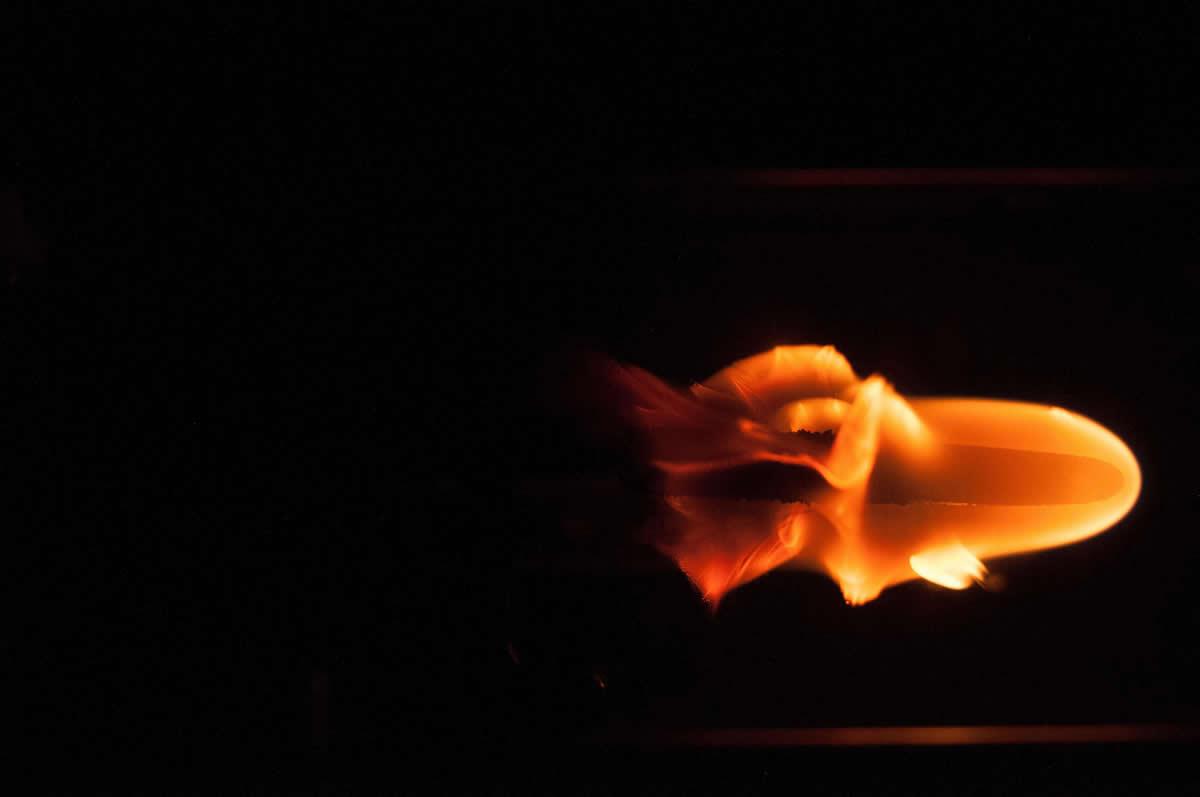
A primary goal of BASS-II is improved spacecraft fire safety, improved understanding of combustion in space and how to avoid it. If you’re on a mission far from Earth, a fire can be catastrophic. BASS-II helps engineers select the safest materials and improve firefighting methods on future space missions. In outer space, fuels burn as oval balls rather than with an upward pointed cone flame as they do on Earth. This simpler combustion process enables researchers to evaluate computer models of fuel burning. These models can then be used to more accurately study flames on Earth, such as in wildfires, building fires, energy recapture from waste recycling, and other combustion problems.
Publications
17 listed in PSI, 9 with a DOI.
- Microgravity flammability boundary for PMMA rods in axial stagnation flow: Experimental results and energy balance analysesOlson Sandra L., Ferkul Paul V.
- Temperature and CO2 fields of a downward spreading flame over thin cellulose: A comparison of experimental and computational resultsBhattacharjee Subrata, Paolini Christopher, Tran Wynn, Villaraza Jeanie Ray, Takahashi Shuhei
- Opposed-flow flame spread: A comparison of microgravity and normal gravity experiments to establish the thermal regimeBhattacharjee Subrata, Laue Matthew, Carmignani Luca, Ferkul Paul, Olson Sandra
- The critical flow velocity for radiative extinction in opposed-flow flame spread in a microgravity environment: A comparison of experimental, computational, and theoretical resultsBhattacharjee Subrata, Simsek Aslihan, Olson Sandra, Ferkul Paul
- Experimental validation of a correlation capturing the boundary layer effect on spread rate in the kinetic regime of opposed-flow flame spreadBhattacharjee Subrata, Tran Wynn, Laue Matthew, Paolini Christopher, Nakamura Yuji
- Results from on-board CSA-CP and CDM Sensor Readings during the Burning and Suppression of Solids - II (BASS-II) Experiment in the Microgravity Science Glovebox (MSG)SL Olson, PV Ferkul, S Bhattacharjee, FJ Miller, C Fernandez-Pello, S Link, JS Tien, I Wichman
Show the other 11
- Modeling and Analysis of Intermediate Thickness PMMA Sheets Burning in Microgravity Opposed FlowTJ Shah, FJ Miller, S Olson, I Wichman
- Concurrent flame growth, spread and extinction over composite fabric samples in low speed purely forced flow in microgravityX Zhao, JS Tien, PV Ferkul, S. Olson
- Radiative, thermal, and kinetic regimes of opposed-flow flame spread: A comparison between experiment and theoryBhattacharjee Subrata, Simsek Aslihan, Miller Fletcher, Olson Sandra, Ferkul Paul
- Concurrent flame growth, spread, and quenching over composite fabric samples in low speed purely forced flow in microgravityZhao Xiaoyang, Liao Ya-Ting T., Johnston Michael C., T'ien James S., Ferkul Paul V., Olson Sandra L.
- A Study of the Effectiveness of a Narrow Channel Apparatus in Simulating Microgravity Flame Spread over Thin FuelsPepper Jacob, Miller Fletcher, Olson Sandra, Wichman Indrek
- BASS-II Summary ReportJ Marcum, S Olson, P Ferkul
- Correlation of normal gravity mixed convection blowoff limits with microgravity forced flow blowoff limitsJW Marcum, SL Olson, PV Ferkul
- Fire in MicrogravityHariharan Ashwin, Miller Fletcher, Olson Sandra, Wichman Indrek
- Microgravity Flammability of PMMA Rods in Concurrent FlowSL Olson, PV Ferkul
- Using a Narrow Channel Apparatus to Study Thermally-Intermediate Fuel Combustion in a Simulated 0g EnvironmentG Bornand, G Sullivan, T Shah, F Miller
- Burning and Suppression of Solids – II Fire Safety Investigation for the Microgravity Science GloveboxSL Olson, PV Ferkul, S Bhattacharjee, FJ Miller, AC Fernandez-Pello, JS Tien
Hardware and raw data
275 GB of raw data on PSI: reports 1, raw data 685, metadata 1, reference data 1, science documents 3, engineering documents 2, representative image(s) 1. FlameLens reads the experimental table, not the raw video or sensor files.
Linked investigations
- BASS
- BASS flame-spread modelling re-analysed this data
On Earth
Fire models: Simpler microgravity flames validate fire models that are then applied to fires on Earth.
“These models can then be used to more accurately study flames on Earth”