Experiments / ACME burners
BREA spacecraft fire-safety study
Burning Rate Emulator
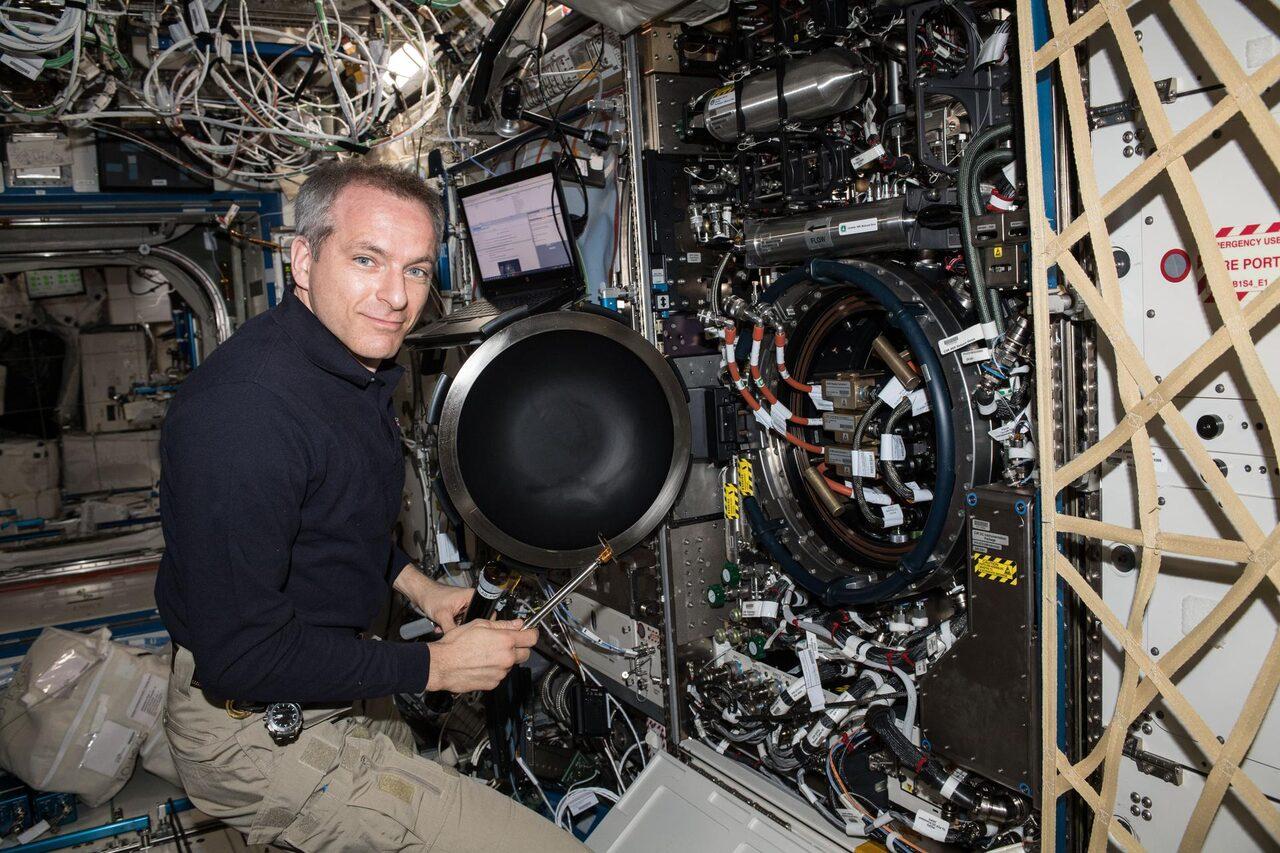
Used a gas burner to imitate burning solids, and tested it in still air at the very atmospheres NASA is considering for exploration.
What burned
Gas
Ethylene and methane. The gas stood in for solid and liquid fuels
Where
On the space station
In orbit, where everything is weightless
How much data
18 test days
NASA's table lists days, each with several flames
What they changed between tests
- oxygen concentration
- pressure
- burner size
- fuel and dilution
What it found
- 1 of 2
BRE deliberately tested the three cabin atmospheres NASA considers for crewed missions, including the 34% oxygen exploration atmosphere.
NASA's words
“NASA - considered atmosphere for human space missions will be examined: 14.7 psia, 21 % oxygen: 10.2 psia, 26.5 %; and 8.2 psia, 34 % oxygen.” PSI record
- 2 of 2
Turning off ventilation - a standard step in fighting a spacecraft fire - did not stop burning in oxygen-enriched atmospheres.
NASA's words
“The ongoing combustion without air flow was notably seen in elevated-oxygen atmospheres which are being considered for use in future spacecraft, whereas such flames in a normal atmosphere of 21% oxygen self-extinguished in a short time.” PSI record
Summarized by the SI. Each summary is tied to a quotation that the build checks against NASA's text. A matching quote is not a scientific review.
What it helps with
Stopping a fire from starting
Which materials burn, and in what air
A main aim
Noticing a fire early
What smoke looks like to a detector
Not an aim
Putting a fire out
What makes a flame go out
A clear part
For researchers: NASA's full recordThe conditions tested, every row of the table, NASA's description, publications and hardware
Shared hardware: Six gas-flame experiments shared one modular set of burners and diagnostics. Experiments that shared hardware share its limits, so their results can be compared directly.
Why it counts as fire-safety research
“the Burning Rate Emulator (BRE) experiment of the Advanced Combustion via Microgravity Experiments (ACME) project was a study of materials flammability in still atmospheres as a function of material properties” NASA challenge statement
Burned gas, but was designed to stand in for solid and liquid fuels.“Emphasize fuel conditions that can be related to a diverse range of condensed fuels.”
NASA's words behind each rating
- Prevention3 of 3
“The BRE flight program seeks to establish the burning conditions in a quiescent microgravity ambient in terms of material properties.”
- Detection0 of 3
Not an aim of this investigation.
- Suppression2 of 3
“the cessation of ventilation is an established step in putting out spacecraft fires”
Conditions covered
- Oxygen in the atmosphere
- 21% to 40%
- airMoon
- Pressure
- not reported
- Moonsea level
- not in the PSI table
- Flow speed
- not reported
- not in the PSI table
- Itemized rows
- 18
- 18 test days
Fuels and materials
ethylene (16), methane (2)
Measurements named in the PSI record
- Heat flux
How the tests differ, and how they are the same
Worked out from the 18 rows of the PSI table. A variable that is not listed was not reported, which is different from being held fixed.
Changed from test to test
- Oxygen
- 21% to 40%
- Fuel or material
- 2 different values
- Fuel fraction
- 50% to 100%
- Characteristic size
- 25 mm to 50 mm
- Flames ignited
- 0 to 21
The same in every test
- Oxygen refers to
- ambient
- Diluent
- N2
- Fuel phase
- gas
- Geometry
- flat porous burner
Rows from the PSI table
Click a row for the source of every value. Filter and export
| Record | Type | Fuel or material | Shape | Oxygen | Pressure | Flow, cm/s | Outcome | Date |
|---|---|---|---|---|---|---|---|---|
| 2019 Feb 8 | Test day | ethylene | flat porous burner | 21% to 40% | not reported | 2019-02-08 | ||
| 2019 Feb 20 | Test day | ethylene | flat porous burner | 26.5% to 34% | not reported | 2019-02-20 | ||
| 2019 Feb 25 | Test day | ethylene | flat porous burner | 21% to 40% | not reported | 2019-02-25 | ||
| 2019 March 4 | Test day | ethylene | flat porous burner | 26.5% to 40% | not reported | 2019-03-04 | ||
| 2019 March 7 | Test day | ethylene | flat porous burner | 34% | not reported | 2019-03-07 | ||
| 2019 March 11 | Test day | ethylene | flat porous burner | 26.5% to 34% | not reported | 2019-03-11 | ||
| 2019 March 28 | Test day | ethylene | flat porous burner | 26.5% to 34% | not reported | 2019-03-28 | ||
| 2019 April 1 | Test day | ethylene | flat porous burner | 21% | not reported | 2019-04-01 | ||
| 2019 April 4 | Test day | ethylene | flat porous burner | 21% to 34% | not reported | 2019-04-04 | ||
| 2020 Sept 3 | Test day | ethylene | flat porous burner | 25% to 40% | not reported | 2020-09-03 | ||
| 2020 Oct 17 | Test day | ethylene | flat porous burner | 26.5% to 34% | not reported | 2020-10-17 | ||
| 2020 Dec 5 | Test day | methane | flat porous burner | 25% to 40% | not reported | 2020-12-05 | ||
| 2020 Dec 4 | Test day | methane | flat porous burner | 25% to 40% | not reported | 2020-12-04 | ||
| 2020 Dec 11 | Test day | ethylene | flat porous burner | 25% to 40% | not reported | 2020-12-11 | ||
| 2020 Dec 17 | Test day | ethylene | flat porous burner | 34% to 40% | not reported | 2020-12-17 | ||
| 2020 Dec 23 | Test day | ethylene | flat porous burner | 25% to 40% | not reported | 2020-12-23 | ||
| 2021 Jan 20 | Test day | ethylene | flat porous burner | 21% to 34% | not reported | 2021-01-20 | ||
| 2021 Jan 28 | Test day | ethylene | flat porous burner | 25% to 40% | not reported | 2021-01-28 |
How the table was read, and what was repaired
Burning Rate Emulator - test days
PSI-20_Experimental table_ACME BRE.csv
18 rows in the file, 18 kept as records. Session summary: PSI lists the oxygen levels of the flames that ignited each day, not individual burns. The table's own note says chamber pressures were also varied but are not identified, so no pressure is assigned.
- Oxygen Conc. (as diluted with nitrogen on a volume basis) was varied between tests where approximate concentrations for tests that ignited are listed. The chamber pressures were also varied but are not identified in this summary table.
- Flames Ignited is the number ignited on that day (neglecting the day change on ISS).
sha256 4aa5d3f98708ceacced5c620d46858b9965f8d4d941b203229f46467d53e5ab7 · fetched 2026-11-11
Repairs and warnings
- Column 'Oxygen Conc (percent)': '3400%' read as '34' in 1 row(s). A percent format was applied to the number 34 in the PSI table; the column is already in percent.
- Column 'Oxygen Conc (percent)': '2100%' read as '21' in 1 row(s). A percent format was applied to the number 21 in the PSI table; the column is already in percent.
NASA's description
Objectives
The BRE flight program seeks to establish the burning conditions in a quiescent microgravity ambient in terms of material properties. The specific flight objectives are as follows. 1. Observe burning behavior in long-duration microgravity for CH4/N2 and C2H4/N2mixtures on porous circular burners of 25 and 50 mm diameter. Consider O2/N2 ambients with various pressures and ambient O2 concentrations and pressures. NASA - considered atmosphere for human space missions will be examined: 14.7 psia, 21 % oxygen: 10.2 psia, 26.5 %; and 8.2 psia, 34 % oxygen. Emphasize fuel conditions that can be related to a diverse range of condensed fuels. 2. Consider the conditions of Objective 1 for ambients of O2/CO2 (desired). 3. Consider the conditions of Objectives 1 – 2 for extinction limits.
Approach
To accomplish the above objectives, flight experiments are proposed. Additionally, preliminary flight tests will be performed to verify the experiment operations and for comparison with ground-based tests. For each test, conditions will be established for the chamber contents, namely choice of diluent, oxygen concentration, and pressure. Fuel flow will commence followed by ignition. The flames will initially be observed without varying the fuel flow rate. Because burner surface temperature and heat flux will vary, this will allow a broad range of conditions to be observed during a single test. As the surface temperature of the burner increases, and the flame remains steady, a continuous set of data is produced for the flammability map. Eventually either the flame will extinguish, the surface temperature of the burner will equilibrate, or the temperature limit of the heat flux sensor will be reached. At this time the fuel flow will be terminated. So a test should terminate for a given flow rate at extinction, and for continued burning when the burner surface temperature has steadied or the temperature limit of the heat flux sensor is neared. The extinction limit could be found once the burner temperature has steadied, and the heat flux sensor has not exceeded its limit. At that state, the flow rate can be reduced in small increments, until extinction is observed and the flow rate shut off. Again, in this process, new data is being produced for the flammability map. Ignition limit tests are not proposed for microgravity, but we will explore these under normal gravity. We believe there is better control on Earth-based ignition testing and that these results should carry over to microgravity conditions. In addition to the flight experiments, in normal gravity testing will continue. These tests will involve gaseous, liquid, and solid fuels. These experiments will further establish the validation of the BRE for 1-g applications and show its usefulness to establish 1-g ignition and extinction limits. As available, drop facility testing will be used to refine procedures, test instrumentation, and help to establish viable flow conditions. We will also pursue a CFD model for the quiescent microgravity burning. This will also guide us in the flight experiments, and potentially provide a predictive methodology.
Hypothesis
The BRE investigation hypothesizes that there can exist a regime of quasi-steady burning in microgravity as a function of materials properties. Steady burning may never be achieved, and only slowly changing unsteady flames are possible. The proposed tests aboard the ISS aims to query this hypothesis by establishing a range of quasi-steady burning conditions for condensed fuels in the microgravity environment. It is hypothesized that BRE can determine a range of burning conditions in microgravity as a function of heat of gasification, reradiation heat flux, applied radiant heat flux, heat of combustion and smoke point. This could enable the Cone Calorimeter (NASA Test 2) test as a basis for establishing flammability maps for real materials. The key hypothesis is that the heat of combustion, smoke point, and heat of gasification of the fuel mixture will represent a real solid fuel (or liquid fuel absorbed in an inert matrix). Thus achieved steady burning would represent the potential for real solid fuels to achieve steady burning in microgravity. Other than a candle flame, this has not been shown before.
Research impacts and Earth benefits
BRE yielded important data relevant to spacecraft fire safety. Quasi-steady burning corresponding to various condensed-phase materials (such as PMMA and Nylon) was observed in microgravity despite the absence of air flow, where the cessation of ventilation is an established step in putting out spacecraft fires. The ongoing combustion without air flow was notably seen in elevated-oxygen atmospheres which are being considered for use in future spacecraft, whereas such flames in a normal atmosphere of 21% oxygen self-extinguished in a short time. While BRE’s results are still preliminary, they suggest that NASA may want to increase use of its alternative flammability Test 2, with the cone calorimeter, where that test can measure material properties corresponding to the microgravity flames observed with the BRE burner.
Publications
16 listed in PSI, 15 with a DOI.
- Burning on flat wicks at various orientationsZhang Yi, Bustamante Michael J, Gollner Michael J, Sunderland Peter B, Quintiere James G
- A Gas Burner to Emulate Condensed-Phase BurningZhang Y., Bustamante M. J., Dotson K. T., Sunderland P. B., Quintiere J. G.
- Experimental Investigation of Liquid and Gas Fueled Flames Towards the Development of a Burning Rate Emulator (BRE) for Microgravity ApplicationsMJ Bustamante
- Burning in microgravity: Experimental results and analysisP Dehghani, PB Sunderland, JG Quintiere, JL deRis
- Transient dynamics of radiative extinction in low-momentum microgravity diffusion flamesSnegirev Alexander, Kuznetsov Egor, Markus Ekaterina, Dehghani Parham, Sunderland Peter
- Emulation of condensed fuel flames with gaseous fuels supplied through a porous copper calorimeterAuth Eric, Quintiere James G., Sunderland Peter B.
Show the other 10
- Radiative Extinction of Laminar Diffusion Flame above the Flat Porous Burner in Microgravity: A Computational StudyKuznetsov E. A., Snegirev A. Yu., Markus E. S.
- Transient ellipsoidal combustion model for a porous burner in microgravityMarkan Akshit, Baum Howard R., Sunderland Peter B., Quintiere James G., de Ris John L.
- Measuring heat flux to a porous burner in microgravityMarkan Akshit, Sunderland Peter B., Quintiere James G., de Ris John L., Baum Howard R.
- Analysis of extinction and sustained ignitionVermina Plathner Frida, Quintiere James G., van Hees Patrick
- A Burning Rate Emulator (BRE) for study of condensed fuel burning in microgravityMarkan Akshit, Sunderland Peter B., Quintiere James G., de Ris John L., Stocker Dennis P., Baum Howard R.
- Study of ignition and extinction of small-scale fires in experiments with an emulating gas burnerLundström Frida Vermina, Sunderland Peter B., Quintiere James G., van Hees Patrick, de Ris John L.
- Emulation of condensed fuel flames with gases in microgravityZhang Yi, Kim Matt, Guo Haiqing, Sunderland Peter B., Quintiere James G., deRis John, Stocker Dennis P.
- Flammability maps for microgravity burning of a small flat material in a quiescent ambientDehghani Parham, Quintiere James G.
- Demonstrating steady burning for small flat materials in microgravity in a quiescent ambientDehghani Parham, de Ris John L., Quintiere James G.
- Theoretical analysis and predictions of burning in microgravity using a burning emulatorDehghani Parham, Quintiere James G.
Hardware and raw data
2 TB of raw data on PSI: experimental table 1. FlameLens reads the experimental table, not the raw video or sensor files.
On Earth
Material flammability standards: A burner that emulates condensed fuels gives a repeatable way to rank the flammability of materials.
“Quasi-steady burning corresponding to various condensed-phase materials (such as PMMA and Nylon) was observed”