Experiments / Ground studies
Supports fire safety
SAME smoke modelling
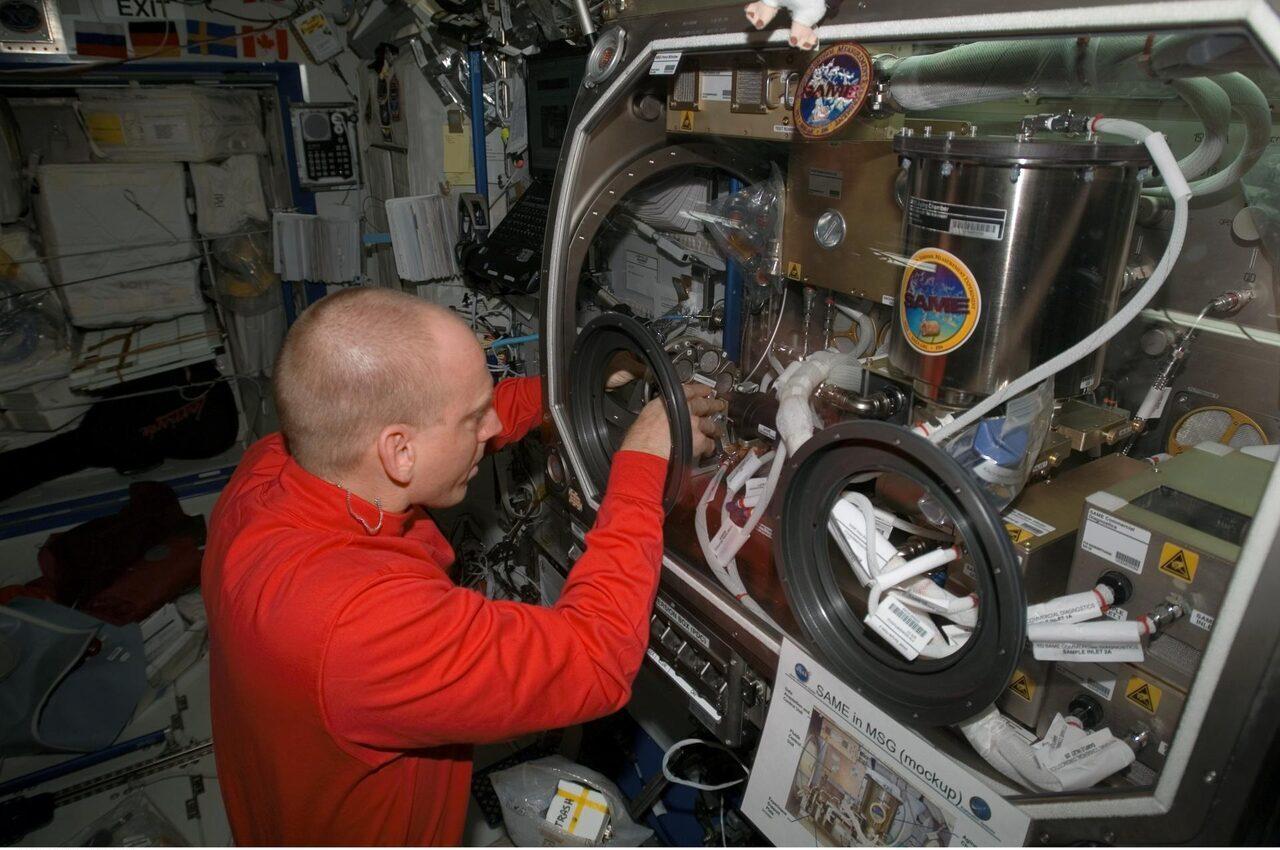
Simulated how smoke particles form and grow with and without gravity, using the SAME experiment as its reference case.
What burned
Solid materials
The things a cabin is made of
Where
On a computer
A computer study, not a new flight test
How much data
No test table
NASA's archive holds its report, not a table of tests
What they changed between tests
- gravity level
- cross-flow velocity
What it found
The goal is to explain, not just record, why microgravity smoke differs from smoke on Earth.
NASA's words
“quantify the differences between microgravity and Earth gravity smoke, and to identify the fluid dynamic mechanisms that cause the differences” PSI record
Summarized by the SI. Each summary is tied to a quotation that the build checks against NASA's text. A matching quote is not a scientific review.
What it helps with
Stopping a fire from starting
Which materials burn, and in what air
Not an aim
Noticing a fire early
What smoke looks like to a detector
A clear part
Putting a fire out
What makes a flame go out
Not an aim
For researchers: NASA's full recordThe conditions tested, every row of the table, NASA's description, publications and hardware
Shared hardware: Later studies that took flight data from PSI and built models or follow-up experiments on it. Experiments that shared hardware share its limits, so their results can be compared directly.
Why it counts as fire-safety research
“This would directly lead to better smoke detection devices and prevent fires that can lead to loss of materiel and loss of life.” PSI record
NASA's words behind each rating
- Prevention0 of 3
Not an aim of this investigation.
- Detection2 of 3
“This would directly lead to better smoke detection devices and prevent fires that can lead to loss of materiel and loss of life.”
- Suppression0 of 3
Not an aim of this investigation.
Conditions covered
- Oxygen in the atmosphere
- not reported
- airMoon
- not in the PSI table
- Pressure
- not reported
- Moonsea level
- not in the PSI table
- Flow speed
- not reported
- not in the PSI table
- Itemized rows
- 0
- no table in PSI
Fuels and materials
Not itemized in PSI.
Measurements named in the PSI record
- Numerical simulation
NASA's description
Objectives
The objective of this investigation was to use numerical simulation to explore the influence of gravity on pyrolysis smoke growth from a fundamental perspective. The intention of this effort is to quantify the differences between microgravity and Earth gravity smoke, and to identify the fluid dynamic mechanisms that cause the differences.
Approach
The formation and growth of dibutyl-phthalate (DBP) particles in Earth gravity and microgravity environments was simulated. Direct numerical simulation via a Navier-Stokes nodal approach was utlilized. The smoke originates from pyrolysis vapor expelled from a heated sample in a geometry similar to that considered in the SAME experiments. This study considered two cross-flow velocities of sufficiently low speed that buoyancy cannot be neglected in the presence of gravity. Simulations are presented to assess the dependence of particle size distributions on thermophoresis, particle settling, and flow geometry. The final report for this investigation introduces the simulation and modeling methodology, followed by a description of the flow geometry and the parameter space under consideration.The differences in the wake geometry attributable to buoyancy for the lower of two flow speeds was examined. Instantaneous scalar fields were used to describe particle accumulation and growth in the buoyant and non-buoyant wakes that form downstream of the hot vapor source.
Hypothesis
Without buoyancy, mixing and heat transfer are reduced, the time-temperature history of the combustion vapors (or particle precursors) and particle trajectories are significantly altered, changing the composition of the smoke. The chemical composition of the burning material also affects the characteristics of the smoke generated.
Research impacts and Earth benefits
Models and tools that characterize particles generated as smoke can be used to ascertain how temperature, gravity, and material properties affect the smoke produced. This would directly lead to better smoke detection devices and prevent fires that can lead to loss of materiel and loss of life.
Publications
0 listed in PSI, 0 with a DOI.
Hardware and raw data
264 MB of raw data on PSI: reports 1, metadata 1, analyzed data 44, science documents 1. FlameLens reads the experimental table, not the raw video or sensor files.
Linked investigations
- SAME uses its flight data
On Earth
Smoke detection: Particle models that support better smoke detectors.
“This would directly lead to better smoke detection devices”