Experiments / SPICE flow duct
SLICEBasic flame science
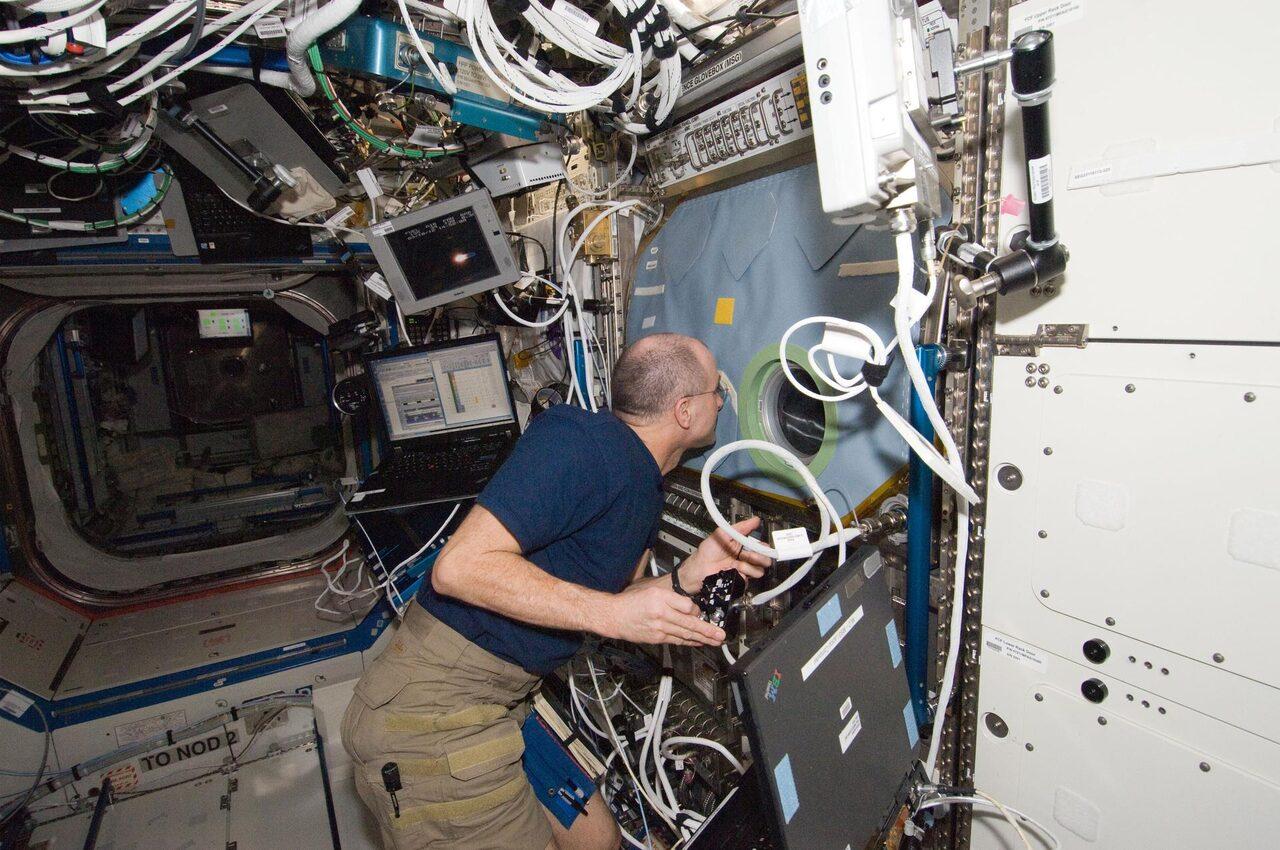
Structure and Liftoff In Combustion Experiment
Found the airflow at which small jet flames lift off their burner and blow out.
What burned
Gas
Methane, ethylene and ethane
Where
On the space station
In orbit, where everything is weightless
How much data
12 test days
NASA's table lists days, each with several flames
What they changed between tests
- fuel
- fuel dilution
- burner diameter
- coflow velocity
What it found
Flame stability in microgravity depends on burner size, airflow and fuel, and differs from Earth.
NASA's words
“are significantly influenced by burner diameter, coflow velocity, and fuel composition and are fundamentally different than flames observed on Earth” PSI record
Summarized by the SI. Each summary is tied to a quotation that the build checks against NASA's text. A matching quote is not a scientific review.
What it helps with
Stopping a fire from starting
Which materials burn, and in what air
Touches on it
Noticing a fire early
What smoke looks like to a detector
Not an aim
Putting a fire out
What makes a flame go out
Touches on it
For researchers: NASA's full recordThe conditions tested, every row of the table, NASA's description, publications and hardware
Shared hardware: One small fan-driven wind tunnel, built for SPICE, was reused for solids and for jet flames. Experiments that shared hardware share its limits, so their results can be compared directly.
Why it counts as fire-safety research
“Other combustion investigations within the PSI database (but not explicitly referenced above) are still relevant to fire safety, just not as strongly or directly.” NASA challenge statement
NASA's words behind each rating
- Prevention1 of 3
“Insights into flame stability and behavior to enhance fire safety.”
- Detection0 of 3
Not an aim of this investigation.
- Suppression1 of 3
“Determine the liftoff velocity limits for different fuels and burner diameters.”
Conditions covered
- Oxygen in the atmosphere
- 21%
- airMoon
- Pressure
- 101 kPa
- Moonsea level
- Flow speed
- not reported
- not in the PSI table
- Itemized rows
- 12
- 12 test days
Fuels and materials
methane (8), ethylene (3), ethane (1)
Measurements named in the PSI record
- Flame imaging
- Radiometry
How the tests differ, and how they are the same
Worked out from the 12 rows of the PSI table. A variable that is not listed was not reported, which is different from being held fixed.
Changed from test to test
- Fuel or material
- 3 different values
- Fuel fraction
- 20% to 100%
The same in every test
- Oxygen
- 21%
- Oxygen refers to
- ambient
- Pressure
- 101 kPaassumed
- Fuel phase
- gas
- Geometry
- coflow jet
Reported for only some rows, with one value: fuel diluent.
Rows from the PSI table
Click a row for the source of every value. Filter and export
| Record | Type | Fuel or material | Shape | Oxygen | Pressure | Flow, cm/s | Outcome | Date |
|---|---|---|---|---|---|---|---|---|
| 2012-FEB-09 | Test day | methane | coflow jet | 21% | 101 kPaassumed | 2012-02-09 | ||
| 2012-FEB-13 SLICE testing with | Test day | methane | coflow jet | 21% | 101 kPaassumed | 2012-02-13 | ||
| 2012-FEB-17 | Test day | methane | coflow jet | 21% | 101 kPaassumed | 2012-02-17 | ||
| 2012-FEB-20 | Test day | ethylene | coflow jet | 21% | 101 kPaassumed | 2012-02-20 | ||
| 2012-FEB-27 | Test day | methane | coflow jet | 21% | 101 kPaassumed | 2012-02-27 | ||
| 2012-MAR-01 | Test day | methane | coflow jet | 21% | 101 kPaassumed | 2012-03-01 | ||
| 2012-MAR-05 SLICE testing with | Test day | methane | coflow jet | 21% | 101 kPaassumed | 2012-03-05 | ||
| 2012-MAR-09 | Test day | ethane | coflow jet | 21% | 101 kPaassumed | 2012-03-09 | ||
| 2012-MAR-12 | Test day | methane | coflow jet | 21% | 101 kPaassumed | 2012-03-12 | ||
| 2012-MAR-15 | Test day | ethylene | coflow jet | 21% | 101 kPaassumed | 2012-03-15 | ||
| 2012-MAR-19 SLICE testing with | Test day | methane | coflow jet | 21% | 101 kPaassumed | 2012-03-19 | ||
| 2012-MAR-23 Last day of testing: SPICE testing with 100% C3H8 and then 100% | Test day | ethylene | coflow jet | 21% | 101 kPaassumed | 2012-03-23 |
How the table was read, and what was repaired
SLICE - test days
PSI-106_Experimental table_Slice.csv
12 rows in the file, 12 kept as records. Session summary - one row per test day, listing the fuel bottle used.
Assumed: Not listed in the PSI table. Taken as ISS cabin pressure, because the experiment ran inside the Microgravity Science Glovebox flow duct built for SPICE.
sha256 89ef980810ca6d9aa8be817b42e36cd2adff23f5e9058361b5a33d18b4363f4d · fetched 2026-11-11
NASA's description
Objectives
Objective: The objective of this investigation is to better understand the structure and stability of laminar diffusion flames in microgravity. Specific objectives of this investigation were: 1. To investigate the structure of laminar diffusion flames in microgravity to understand the stabilizing mechanisms at the flames base. 2. Determine the liftoff velocity limits for different fuels and burner diameters. 3. Evaluate the impact of fuel dilution with nitrogen on soot formation and flame stability. 4. Quantify the effects of microgravity on flame length and radiative heat loss compared to normal gravity conditions. 5. Validate numerical models for flame dynamics, soot production, and thermal radiation in non-premixed flames.
Approach
The SLICE apparatus consisted of a fan-driven flow duct, exchangeable burner tubes, and integrated sensors to measure flow rates and temperature. This setup used several fuels such as methane, ethylene, and nitrogen-diluted mixtures. Flames were then manually ignited and observed under controlled coflow air conditions. A high resolution camera captured still images while sensor data was overlaid on these images. Calibration tests for airflow velocity, soot measurement, and the fans were conducted to ensure the accuracy of the results. More than 4,000 high-resolution images were captured across 13 testing experiments. Data was then analyzed to correlate flame structure with stability with flow dynamics and fuel properties.
Hypothesis
The hypothesis is that the structure and stability of laminar diffusion flames in microgravity are significantly influenced by burner diameter, coflow velocity, and fuel composition and are fundamentally different than flames observed on Earth.
Research impacts and Earth benefits
1. Improved numerical models for flame behavior lead to more efficient combustion technologies on Earth. 2. Understanding soot formation aids in designing combustion systems with minimum emissions. 3. Insights into flame stability and behavior to enhance fire safety. 4. Findings will inform the development of cleaner, more efficient engines and industrial burners.
Publications
5 listed in PSI, 4 with a DOI.
- A computational and experimental study of coflow laminar methane/air diffusion flames: Effects of fuel dilution, inlet velocity, and gravityCao S., Ma B., Bennett B.A.V., Giassi D., Stocker D.P., Takahashi F., Long M.B., Smooke M.D.
- A Combined Experimental and Computational Study of Soot Formation in Normal and Microgravity ConditionsDobbins Richard R., Tinjero Jesse, Squeo Joseph, Zhao Xinyu, Hall Robert J., Colket Meredith B., Long Marshall B., Smooke Mitchell D.
- Effects of Fuel Dilution and Gravity on Laminar Coflow Methane-Air Diffusion Flames: A Computational and Experimental InvestigationS Cao, BAV Bennett, B Ma, D Giassi, DP Stocker, F Takahashi, MB Long, MD Smooke
- An experimental and computational study of soot formation in a coflow jet flame under microgravity and normal gravityMa Bin, Cao Su, Giassi Davide, Stocker Dennis P., Takahashi Fumiaki, Bennett Beth Anne V., Smooke Mitchell D., Long Marshall B.
- Analysis of CH* concentration and flame heat release rate in laminar coflow diffusion flames under microgravity and normal gravityGiassi Davide, Cao Su, Bennett Beth Anne V., Stocker Dennis P., Takahashi Fumiaki, Smooke Mitchell D., Long Marshall B.
Hardware and raw data
72.9 GB of raw data on PSI: experimental table 1. FlameLens reads the experimental table, not the raw video or sensor files.
Linked investigations
On Earth
Cleaner combustion: Cleaner, more efficient engines and industrial burners.
“Findings will inform the development of cleaner, more efficient engines and industrial burners.”