Experiments / Saffire flow duct
Saffire-IIIA spacecraft fire-safety study
Spacecraft Fire Experiment - III
Repeated the large-fabric burn of Saffire-I at a higher airflow, 30 cm/s instead of 20 cm/s.
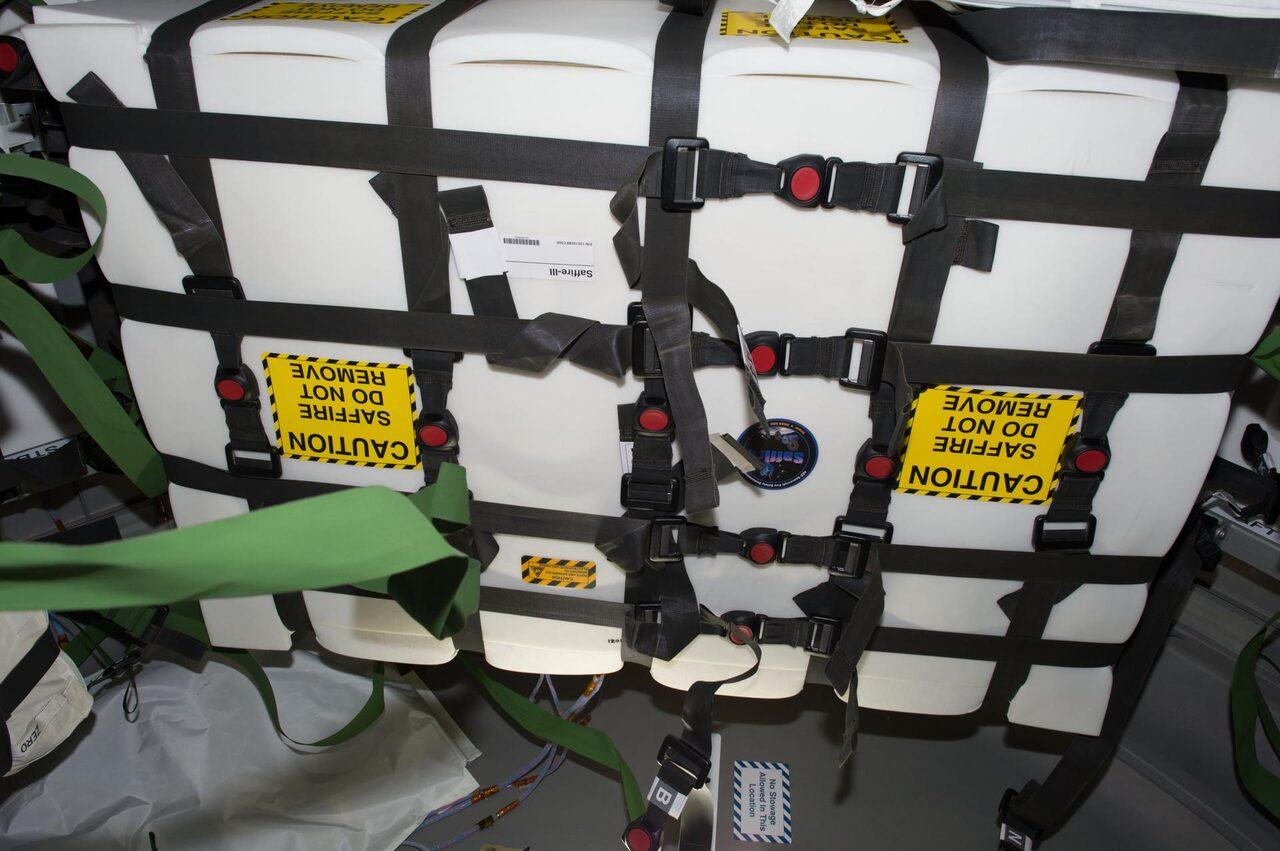
What burned
Solid materials
Cotton fabric
Where
In a cargo ship
After it left the space station, with no crew aboard
How much data
2 tests
Each one is a row in NASA's table
What they changed between tests
- flow speed
- flow direction
What it found
Saffire-III changes one thing relative to Saffire-I - the airflow - so the pair isolates the effect of ventilation on a large fire.
NASA's words
“the experiments were conducted at a flow velocity of 30 cm/s compared to 20 cm/s during Saffire I” PSI record
Summarized by the SI. Each summary is tied to a quotation that the build checks against NASA's text. A matching quote is not a scientific review.
What it helps with
Stopping a fire from starting
Which materials burn, and in what air
A main aim
Noticing a fire early
What smoke looks like to a detector
Touches on it
Putting a fire out
What makes a flame go out
Not an aim
For researchers: NASA's full recordThe conditions tested, every row of the table, NASA's description, publications and hardware
Shared hardware: A large flow duct flown in an uncrewed cargo ship after it left the station, so that a big fire could be lit safely. Experiments that shared hardware share its limits, so their results can be compared directly.
Why it counts as fire-safety research
“Flammability studies focus on solid materials such as fabrics and plastics, as studied in the Burning and Suppression of Solids (BASS and BASS-II) and Spacecraft Fire Safety Demonstration (Saffire-I, -II, and -III) investigations.” NASA challenge statement
NASA's words behind each rating
- Prevention3 of 3
“investigate the low-g flammability limits compared to those obtained in NASA’s normal gravity material flammability screening test”
- Detection1 of 3
“solid state sensors were used to measure pressure, CO2 and O2 mole faction”
- Suppression0 of 3
Not an aim of this investigation.
Conditions covered
- Oxygen in the atmosphere
- 21% to 21.2%
- airMoon
- Pressure
- 99.4 kPa
- Moonsea level
- Flow speed
- 30 cm/s
- Itemized rows
- 2
- 2 tests
Fuels and materials
SIBAL fabric (cotton/fiberglass) (2)
Measurements named in the PSI record
- Flame imaging
- Radiometry
- Thermocouples
- Gas analysis
- Flow velocity
How the tests differ, and how they are the same
Worked out from the 2 rows of the PSI table. A variable that is not listed was not reported, which is different from being held fixed.
Changed from test to test
- Pressure
- 99.4 kPa
- Flow direction
- 2 different values
- Burn time
- 60 s to 300 s
- Flame spread rate
- 0.98 mm/s to 2.3 mm/s
- Burn length
- 10 cm to 84 cm
The same in every test
- Oxygen
- 21% to 21.2%
- Flow speed
- 30 cm/s
- Fuel or material
- SIBAL fabric (cotton/fiberglass)
- Fuel phase
- solid
- Geometry
- fabric sheet
- Sample thickness
- 3.3 mm
- Sample length
- 94 cm
- Sample width
- 40.6 cm
- Igniter power
- 182 W
- Ignition time
- 8 s
Reported for only some rows, with one value: burn length at 1 g.
Rows from the PSI table
Click a row for the source of every value. Filter and export
| Record | Type | Fuel or material | Shape | Oxygen | Pressure | Flow, cm/s | Outcome | Date |
|---|---|---|---|---|---|---|---|---|
| Sample S1 | Test | SIBAL fabric (cotton/fiberglass) | fabric sheet | 21% to 21.2% | 99.4 kPa | 30 | ||
| Sample S2 | Test | SIBAL fabric (cotton/fiberglass) | fabric sheet | 21% to 21.2% | 99.4 kPa | 30 |
How the table was read, and what was repaired
Saffire-III - samples
PSI-100_Experimental table_SAFFIRE-3.csv
2 rows in the file, 2 kept as records. The PSI table does not list oxygen for Saffire-III, so these samples are not placed on the oxygen-pressure map.
sha256 4d3c717ec20dd0247db670b2784a9fd7d746788bc54a936f80693e48eb8cd117 · fetched 2026-11-11
Repairs and warnings
- Sample S1, Sample thickness: the experimental table gives 3.3 mm; NASA's file NTRS-20180005168.pdf gives 0.37 mm (p. 30, Table 1, row III-1, column Thickness). The table's value is the one used.
- Sample S1, Flow speed: the experimental table gives 30 cm/s; NASA's file NTRS-20180005168.pdf gives 25 cm/s (p. 30, Table 1, row III-1, column Flow). The table's value is the one used.
- Sample S2, Sample thickness: the experimental table gives 3.3 mm; NASA's file NTRS-20180005168.pdf gives 0.37 mm (p. 30, Table 1, row III-2, column Thickness). The table's value is the one used.
- Sample S2, Sample length: the experimental table gives 94 cm; NASA's file NTRS-20180005168.pdf gives 10 cm (p. 30, Table 1, row III-2, column Length). The table's value is the one used.
- Sample S2, Flow speed: the experimental table gives 30 cm/s; NASA's file NTRS-20180005168.pdf gives 25 cm/s (p. 30, Table 1, row III-2, column Flow). The table's value is the one used.
NASA's description
Objectives
The objectives of this investigation were to: (1) determine how rapidly a large scale fire grows in low-gravity and (2) investigate the low-g flammability limits compared to those obtained in NASA’s normal gravity material flammability screening test.
Approach
The Saffire-III experiments were performed on the Orbital Science’s Cygnus resupply vehicle after it deberthed from the ISS. As a follow on to the Saffire 1 investigation, the Saffire III investigation also used SIBAL as the sample material. However, the experiments were conducted at a flow velocity of 30 cm/s compared to 20 cm/s during Saffire I. The flow was either concurrent or opposed. Once the sample was ignited flame images were captured using two cameras. In addition, thermocouples provided flow, flame, and plume temperatures, two radiometers recorded flame radiation, solid state sensors were used to measure pressure, CO2 and O2 mole faction, and two anemometer tracked flow velocity. All data was compressed, and subsequently downlinked. Details related to samples and experimental parameters are provided in the Experimental Details file in the Science document folder.
Hypothesis
This investigation hypothesizes that due to large differences between fire behavior in normal and reduced gravity, the use of terrestrial fires and fire standards to design spacecraft fire safety systems presents an inherent risk to the vehicle because of the significant level of uncertainty. While this approach has been successful thus far, the uncertainty and risk will increase as exploration missions venture further from earth with considerably longer transit times for a safe return. There is a significant lack of microgravity data available for spacecraft designers on which to base their fire safety designs and procedures. To address this knowledge gap, this investigation proposed to conduct large-scale fire safety experiments in an expendable spacecraft without risk to a crew.
Research impacts and Earth benefits
The Saffire-I experiment provides a new way to study a realistic fire on an exploration vehicle, which has not been possible in the past because the risks are too high. Instruments on an unmanned cargo vessel measure oxygen, carbon dioxide, heat, pressure and flame growth, and two video cameras provide views of the flame. Results determine microgravity flammability limits for several spacecraft materials, help to validate NASA’s material selection criteria, and how microgravity and limited oxygen affect flame size. The investigation is crucial for the safety of current and future space missions. Studying fire in small, sealed environments such as the Cygnus cargo supply vehicle benefits fire safety and prevention efforts on Earth, including inside mines, airplanes, or submarines.
Publications
3 listed in PSI, 0 with a DOI.
- Buoyant Effects on the Flammability of Silicone Samples Planned for the Spacecraft Fire Experiment (Saffire), 45th International Conference on Environmental Systems ICES-2015-[293] 12-16 July 2015, Bellevue, WashingtonJE Niehaus, PV Ferkul, SA Gokoglu, GA Ruff
- The Spacecraft Fire Experiment (Saffire) - Objectives, Development and StatusW Schoren, GA Ruff, DL Urban
- Operation and Development Status of the Spacecraft Fire Experiments (Saffire), 46th International Conference on Environmental Systems (ICES), July 2016https://ntrs.nasa.gov/citations/20170000230
Hardware and raw data
35.2 GB of raw data on PSI: raw data 75, presentations 3, science documents 5, engineering documents 2. FlameLens reads the experimental table, not the raw video or sensor files.
Linked investigations
On Earth
Material flammability standards: Results test whether NASA's material selection criteria hold up, which informs flammability screening generally.
“help to validate NASA’s material selection criteria”